
Table of Contents
Your feet may be “sleeping” inside your shoes.
Let’s first reach a consensus: modern athletic shoes are an engineering marvel but also a “coffin” for our feet.
Thick, cushioned midsole, narrow toe space, overly supportive arch support… these designs, while protecting us, have also successfully caused our feet to “degenerate.”
It’s like wearing a neck brace every day; eventually, your neck muscles will atrophy.
When you take off your shoes and stand barefoot on the floor, do you feel your feet collapsing, your toes weak, and even experience a dull ache in the soles after walking for a while?
This is why the benefits of barefoot training have been repeatedly mentioned by the sports science community in recent years.
But this doesn’t mean you should immediately throw away your running shoes and run a marathon—that’s a one-way ticket to fractures.
You need a transition, a “gym,” to awaken your dormant foot muscles. And the balance board is that severely underestimated, perfect bridge from one end to the other.
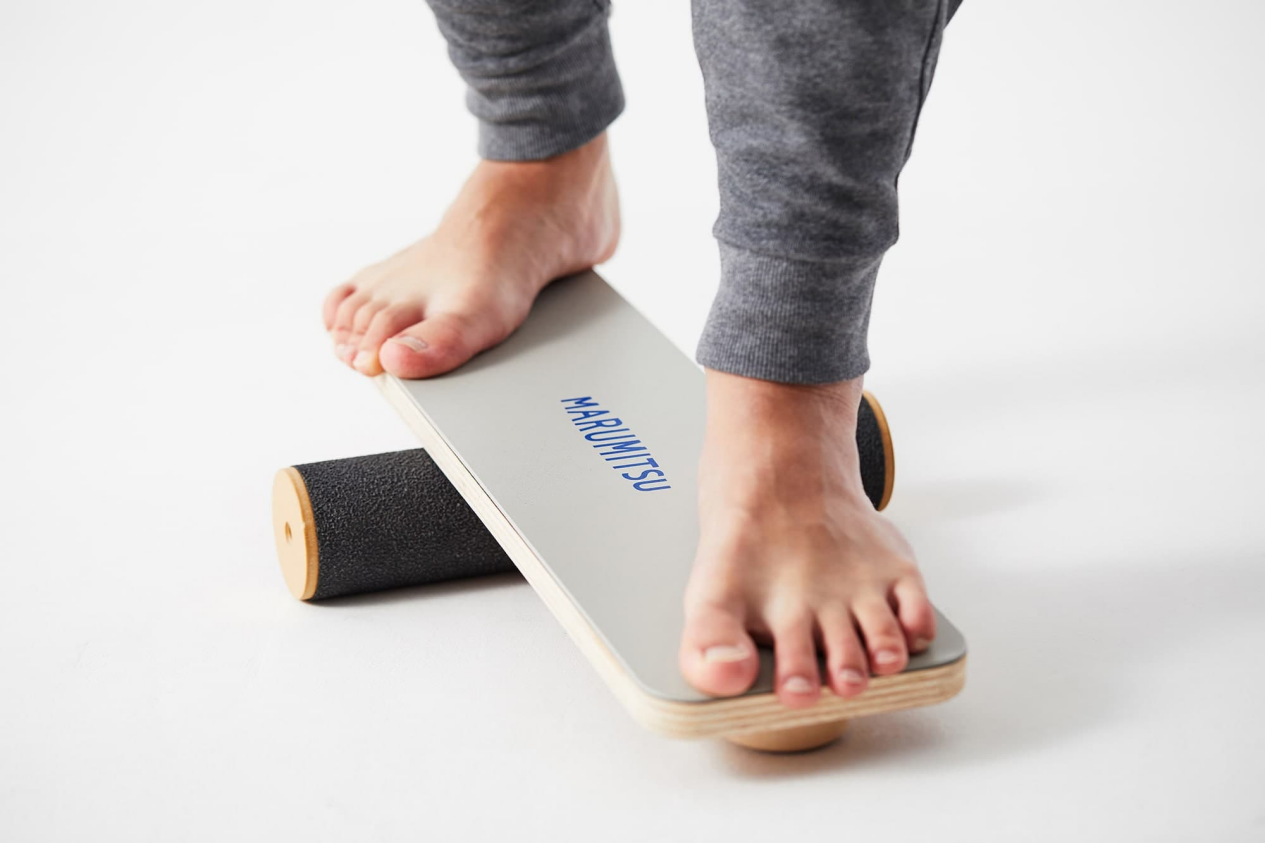
Awakening the Sleeping Giant: Foot Intrinsics
Most people train their chest, back, and legs when they work out, but they neglect the body’s only foundation—the feet.
Anatomically, this is called foot intrinsics.
These are tiny muscle layers deep inside the sole of the foot, responsible for maintaining the shape and elasticity of the arch.
When you stand on a flat, hard floor, the passive support from the bones and ligaments is sufficient, and these small muscles can continue to “slack off.”
But when you stand barefoot on the balance board, the situation changes completely.
The “forced grip” caused by instability
The balance board creates an environment where you sway back and forth and side to side.
To avoid slipping, your brain instinctively sends a signal to your toes:
Hold on tight!
This gripping motion isn’t a conscious toe curl but a deep neural reflex.
In this process, your big toe—a key anchor point in the arch of your foot—must press down forcefully. This action directly activates the abductor hallucis muscle.
You can think of the Balance Board as an amplifier that amplifies the weak signals from the ground to the sole of your foot tenfold, forcing those atrophied muscles to awaken and begin working.
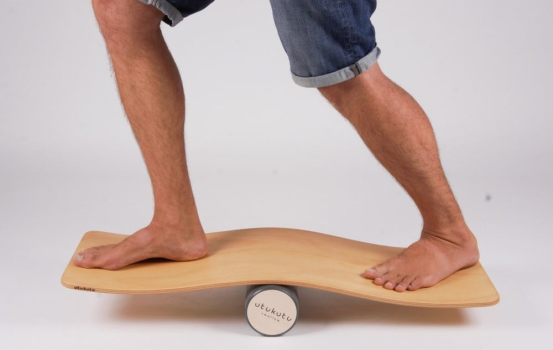
Reshaping the arch of the foot: Say goodbye to the chain reaction of “collapse.”
For people suffering from flat feet, the balance board is not just a training tool but also a corrective measure.
Kinetic chain from the arch of the foot to the knee
You may have heard of “knee valgus.” Often, this is not a problem with the knee itself, but rather a problem with the foundation.
- Collapsed arch (flat feet).
- The ankle then tilts inward (overpronation).
- The tibia (shinbone) is forced to rotate internally.
- The knees buckle inward, creating a twisting force.
This is why many people who do exercises to improve flat feet eventually find that their knee pain also disappears.
When training on a balance board, to maintain the board’s level, you must establish a so-called “short foot” state—that is, artificially arching the foot by contracting your muscles to shorten the distance between the base of your big toe and your heel.
This dynamic, gravity-defying arch-building training is far more effective than statically stepping on a tennis ball or gripping a towel because it teaches the body how to maintain arch rigidity under load.
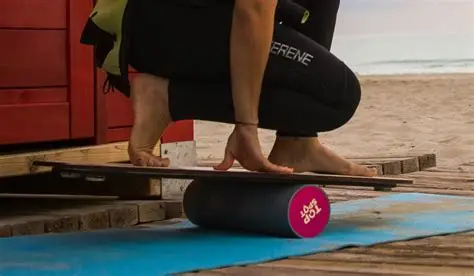
How to safely embark on a Balance Board barefoot journey
If you want to perform plantar fasciitis rehabilitation exercises or arch strengthening, remember: you must go barefoot. Wearing socks will cause slipping, and wearing shoes will block sensation.
Phase 1: Passive Sensing (Activation of Plantar Fascia)
Don’t try to stand on one leg at a high level right away.
Choose a balance board with a non-slip matte finish or natural wood grain surface to provide sufficient friction.
- Sit with both feet on the board.
- Close your eyes and focus on feeling every point where your skin touches the board.
- Slowly tilt the board and feel the plantar fascia stretch and contract as the board angle changes. This is an excellent dynamic massage.
Phase Two: Active Building (Strengthening Foot Arch Strength)
- Stand with your feet shoulder-width apart.
- Try to keep the board level.
- Key point: Imagine your feet as a tripod (big toe ball, little toe ball, heel). Press these three points firmly into the board while trying to “pull” your big toe and heel closer together on the board.
You will feel a strong soreness in the arch of your foot, which is a sign that your muscles are strengthening.
Experts advise that many beginners experience foot pain due to a hard surface.
This is because the fat pads on the soles of the feet have atrophied.
It is recommended to choose a balance board with a cork layer on the surface, which provides sufficient firmness feedback while offering a natural, skin-friendly feel, making it the perfect companion for barefoot training.
Take off your shoes and rediscover your instincts.
We are born barefoot.
Our feet have sophisticated shock-absorbing structures and sensory nerves; they don’t need excessive protection, they need proper use.
The Balance Board isn’t meant to turn you into an acrobat; its ultimate goal is to allow you to unconsciously use the power of your feet to walk even when you’re off it and wearing shoes.
When your arches become as springy as springs again, you’ll find that your entire posture will be transformed, whether you’re running, squatting, or simply walking.
Starting today, give your feet 10 minutes of “free time” every day.
FAQ
Q1: I have severe plantar fasciitis; can I use a balance board?
It depends on your stage.
If you experience excruciating pain when you first get out of bed in the morning (acute phase), do not stand on it, as this will worsen the inflammation.
However, if you are in the chronic recovery phase, a balance board is an excellent tool. It stretches and strengthens the fascia through eccentric loading. It is recommended to start in a seated position, controlling the intensity to avoid overexertion.
Q2: Why do my legs cramp up after standing on the balance board for a while?
This is a good sign, even though it feels uncomfortable.
It indicates that your foot intrinsics are too weak; they are not used to this high-intensity contraction, so they quickly “go on strike” and cramp.
It is recommended to shorten the training time, such as standing for only 30 seconds per set, and gradually strengthen the arch of your foot.
Q3: Will barefoot training widen my feet?
It won’t widen your foot bones, but it will allow your feet to “spread out.”
Wearing narrow-toed shoes for extended periods can cause your toes to squeeze together.
Through balance board exercises and barefoot training, your toes will naturally splay out, returning to a fan shape.
This not only increases the contact area and improves stability, but it’s also a healthy, natural foot shape. You might find yourself needing to buy shoes with a wide toe box, but this is actually a sign of healthy feet.