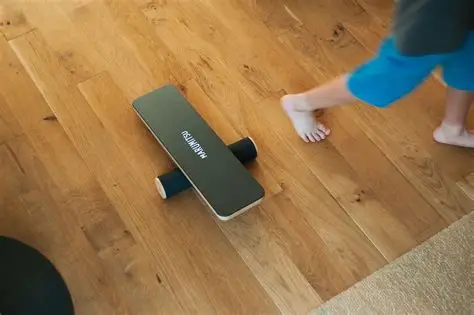
I’ve been practicing on a balance board for a long time, but my core is still unstable?

Table of Contents
Your core may be “pretending” to work.
You bought the Balance Board with high expectations and practiced on it for a month, but the results were disappointing: you still couldn’t calmly drink water on the board, and after each workout, you didn’t feel your abs but instead had back pain.
At this point, most people’s first reaction is, “My core is too weak; I need to practice more.”
Please pause for a moment. As an expert who has long observed human biomechanics, I have to tell you a counterintuitive fact: if core training is ineffective, it’s usually not because you’re not training enough, but because you’re training “wrong.”
The human body is a very clever “cheating master.” When the core muscles cannot cope with instability, the body will automatically call on other strong but incorrect muscles to compensate. Those few seconds when you seem to be standing still on the balance board may be entirely a “false balance” achieved by gripping your toes, using your waist to assist, and holding your breath.
Today, we’ll act like bomb disposal experts, investigating these five hidden errors that are secretly undermining your training results.
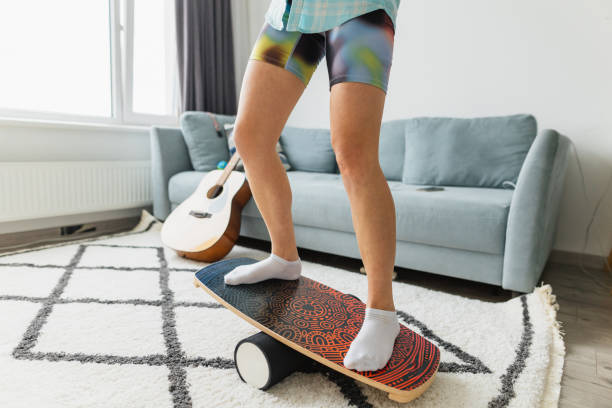
Mistake 1: Toe Clawing
This is almost the first common mistake that all beginners make with balance boards.
When you feel unsteady, your survival instinct will make you grip the board like an eagle’s claws. You think this will give you a stronger grip, but in reality, you’re cutting off the transmission of nerve signals.
Analysis of the principle: The foundation of balance lies in the three-point support of the sole of the foot (big toe ball, little toe ball, and heel). When you excessively curl your toes, the plantar fascia becomes overly tense, leading to a reduction in the contact area of the foot. Worse still, this tension can travel up the fascial chain, locking your ankle.
Consequence: Stiff ankles prevent fine-tuning, and you lose your first line of defense for balance.
Corrective measure: Relax your toes. Imagine you are “laying” your feet on the balance board, allowing your ten toes to spread naturally and gently press against the surface.
Mistake 2: Staring intently at your feet (Visual Lock)
“I need to keep an eye on it so I don’t fall.” This is another huge misconception.
Principle Analysis: The human balance system relies on three elements: vision, the vestibular system (inner ear), and proprioception. When you look down and stare intently at the board or rollers under your feet, you not only put your cervical spine in an incorrect bending position, but more importantly, you deprive the vestibular system of its ability to perceive the spatial position of your head.
Consequence: Your brain loses its “horizontal” reference, causing your body to sway more easily. This is also why many people feel dizzy after practicing for a long time.
Correction: Look up and fix your gaze on a stationary point 3-5 meters in front of you. Trust your feet and let peripheral vision perceive the board’s swaying, rather than staring at it with your central vision.
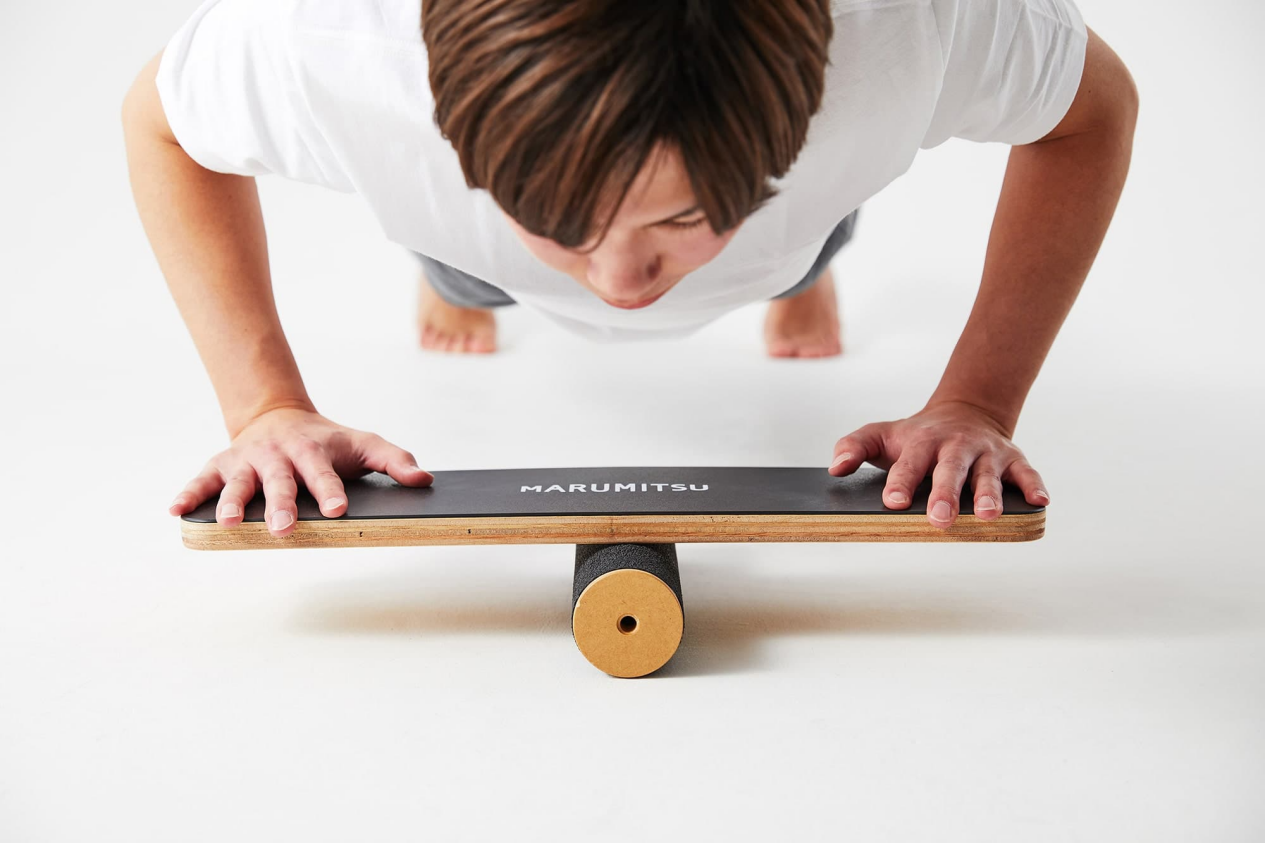
Mistake 3: Excessive Breath Holding
Think back carefully: when you tried to stay still on the board, did you stop breathing?
Analysis of the principle: Holding your breath can indeed create the illusion of a rigid body by increasing intra-abdominal pressure. However, this is a “rigid” stability, not a “dynamic” stability.
as a result of: The core of balance board training is “flow.” Once you hold your breath, your diaphragm locks in, and your core muscles become like rigid rocks, unable to react quickly to the slightest changes in the board. This also leads to oxygen deficiency and unnecessary increases in blood pressure.
Solution: Force yourself to talk or sing. If you can chat freely on the board, it means your core is truly working, not just holding your breath and forcing yourself to stay awake.
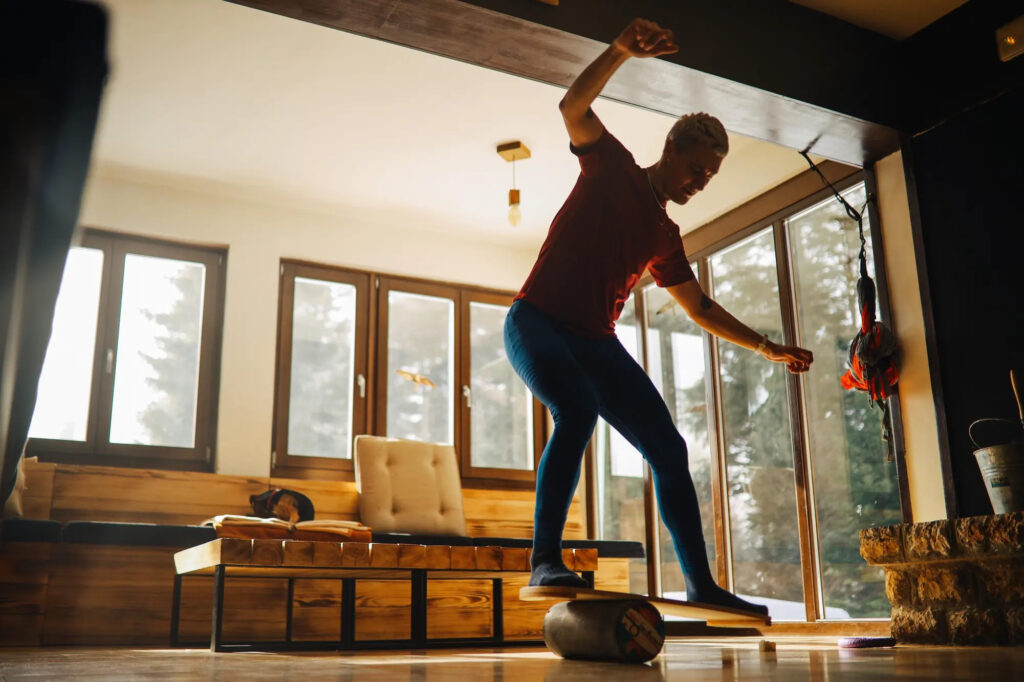
Mistake 4: Anterior Pelvic Tilt and “Perky Butt”
This is the prime suspect in explaining why you experience lower back pain after exercising.
To maintain balance, many people subconsciously stick their buttocks out and lean their upper body forward, forming a folded posture.
Analysis: This posture severs the connection to the abdominal core, transferring all the pressure to the erector spinae muscles in the lower back. You’re not training your core; you’re inducing lower back muscle strain.
Consequences: The abdominal muscles are stretched and weak, receiving no exercise at all, while the lumbar spine bears enormous shear force.
Corrective measures: The key to correcting motor compensation is “coccyx curl.” Imagine you’re pulling your belt buckle upwards, gently contracting your hips to return your pelvis to a neutral position. Your spine should be a vertical line, not a zigzag.
Mistake Five: Speed over Control
On social media, we often see expert users rapidly shaking their balance boards. Beginners often imitate this shaking, thinking that the faster they shake, the more skilled they are.
Principle Analysis: Rapid left-right swaying often uses inertia to mask a lack of control. True core control lies in the ability to “decelerate” and “come to a standstill.”
Consequences: This ineffective shaking, apart from wearing down the rollers, provides negligible stimulation to the neuromuscular system.
Correction: Slow down. Try stopping the board at any angle for 3 seconds. Being able to slow down is the mark of a master.
Advanced exploration: If you have corrected the above posture but still feel that the board under your feet is “uncontrollable,” it may be that the size of your board or the diameter of your rollers is not suitable for your height.
Failure is the best feedback
On the balance board, every loss of balance and every touch to the ground is not a failure but valuable feedback from your body. It’s honestly telling you, “Hey, just a second ago, your attention wandered” or “Your left gluteus medius was slacking off.”
Don’t be discouraged if your core training doesn’t seem to be working. Real progress often happens when you stop fighting gravity and learn to dance with instability. Once you correct these invisible compensatory patterns, you’ll discover that so-called “core strength” is actually a holistic integration of mind and body, encompassing not only muscles but also breathing, nerves, and focus.
Next time you stand on it, remember to relax your toes, look ahead, take a deep breath, and tuck your pelvis.
FAQ
Q1: Is it normal to experience soreness in the front of the calves when I first start doing balance board exercises?
This is perfectly normal. It’s usually because your tibialis anterior muscle is overworking. Beginners often tend to use excessive ankle dorsiflexion for balance instead of fine-tuning their center of gravity. As you learn to use your hips to control your balance, this calf soreness will gradually disappear. If the soreness is severe, shorten the duration of each training session.
Q2: Can I practice while holding onto a wall to prevent falling?
Yes, but there’s a technique. Don’t “grip” the wall with your hands; instead, gently place one or two fingers on the wall as a tactile reference (touch point). Your goal is to gradually reduce your reliance on your fingers until you can completely let go. If you keep gripping the wall, your core will never learn to bear weight independently, which is the first step in correcting motor compensation.
Q3: Why can I hold a plank for 3 minutes on the floor but not even 10 seconds on a bench?
This is a classic misconception. Floor planks primarily train core “static endurance,” which is about maintaining a steady, rigid posture. Balance boards, on the other hand, train “reactive stability.” Your nervous system needs to process numerous tiny disturbances per second, which places entirely different demands on proprioception. This is the so-called “functional” difference.