Afraid of falling? Hesitant to use the Balance Board? We’ll provide beginners with a fear-free, safe start to the journey.

Table of Contents
The “fall simulator” in the shopping cart
You’ve been eyeing the Balance Board on the screen for a long time. You know it works your core, you know it’s cool, and you know all the surfers and ski pros use it.
But as your finger hovers over “Buy Now,” images automatically play in your mind: the board flying out, you landing flat on your back, maybe even twisting your ankle or crashing into the TV.
This fear is perfectly normal.
As humans, our reptilian brains, after millions of years of evolution, have a single purpose: to keep our feet firmly planted on solid ground.
When faced with a deliberately unstable plank, your brain sounding the alarm isn’t cowardice but rather a survival instinct.
But here’s the secret: overcoming fear of exercise doesn’t mean you have to take unnecessary risks.
Real safe use of a balance board isn’t about courage but about physics and environmental setup.
Today, I’m going to break down this tool, which might seem like a “fall trap,” into a safe game that you can completely control.
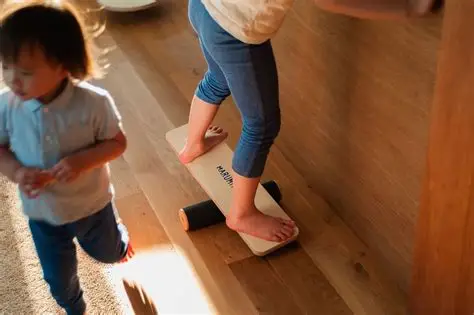
Step 1: Install “brakes” on your board.
Most balance board tutorials for beginners make a fatal mistake: showing models gliding effortlessly on smooth wooden floors or tiles.
That’s master-level play; for beginners, it’s like running on ice.
To practice balance board training without falling, your first ally is friction.
Looking for a long-pile rug (Shaggy Carpet)
If this is your first time working on a board, please make sure to do so on a thick, long-pile carpet.
Physical principle: Long fibers get stuck between the roller and the floor, greatly increasing rolling resistance.
Experience: On a carpet, the roller’s movement speed is slowed down by more than 50%. It’s no longer the uncontrollable feeling of sliding away in a flash but rather a sluggish sensation, like moving through thick honey. This sluggishness gives your brain enough time to adjust its center of gravity.
If you don’t have a carpet, a thick yoga mat is a good alternative, but remember not to start directly on a hard floor.
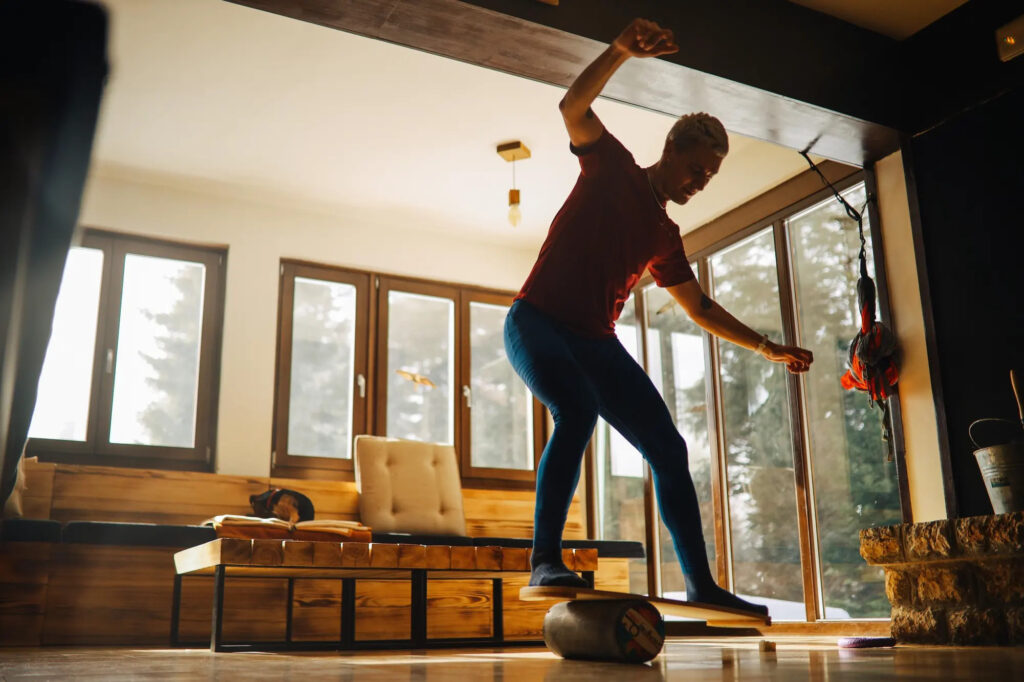
Step Two: Find Your “Guardian Angel”—The Doorway Method
In this unstable world, you need to find an absolutely stable anchor point first.
The Doorframe Technique
This is the most effective introductory technique I’ve ever seen, yet it’s rarely mentioned.
Place the Balance Board in the middle of any doorframe in your home.
When you stand on it, you can naturally hold onto the door frame on both sides with your hands.
Psychological safety: The doorframe is the strongest part of a house structure. When you hold these two “stabilizing anchors” in your hands, your fear of falling will instantly decrease by 90%.
Instructions: Don’t grip the door frame tightly; instead, lightly place your fingers on it. Your goal is to balance using your core strength, not your arm strength. If you feel unstable, squeeze your fingers firmly to regain your balance immediately.
If you can’t find a suitable door frame, a high-backed sofa or a kitchen island can provide the same support.
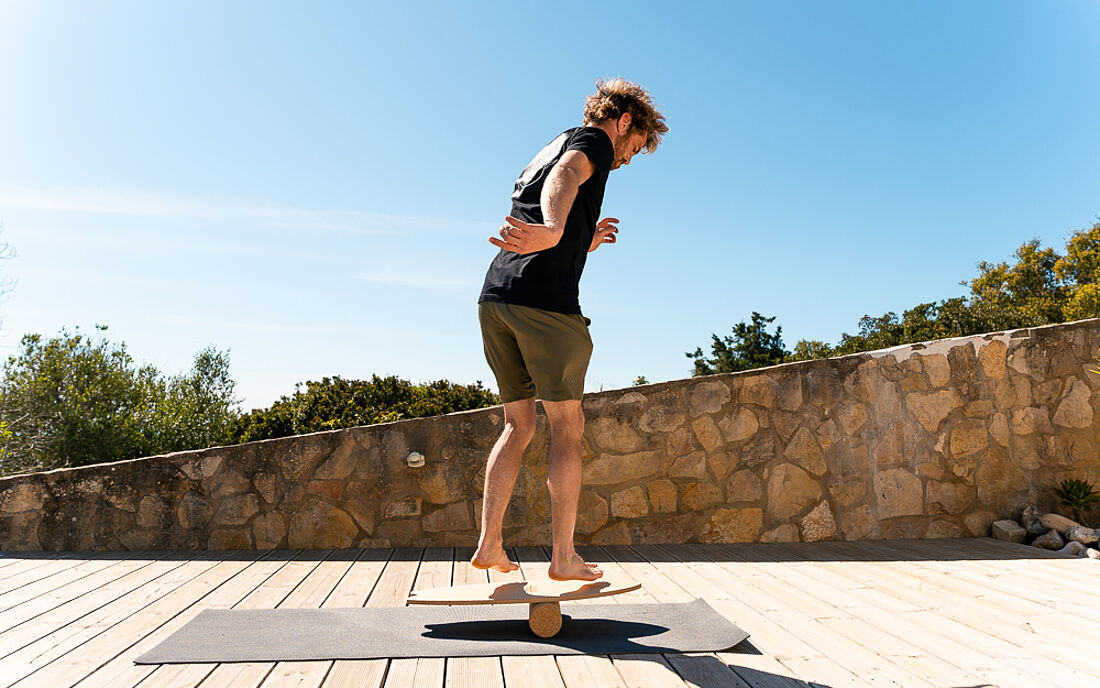
Step 3: Micro-swinging practice—The art of accepting imbalance
Many beginners fall because they try to achieve “perfect stillness.”
As soon as the board tilts slightly, they panic and make drastic corrections, resulting in the board slamming out onto the other side of the ground (bottoming out) and losing their balance.
The sway is only 1 centimeter.
At first, don’t try to balance the board perfectly above the rollers.
- First, let one end of the board touch the ground as the starting position.
- Slowly shift your weight, try to lift one end of the board only 1 centimeter off the ground, and then immediately put it down.
It’s like testing the water temperature. Raise the left side by 1 centimeter, then lower it; raise the right side by 1 centimeter, then lower it.
This “micro-swinging” exercise allows your vestibular system to gradually adapt to the feeling of swaying. You need to tell your brain, “See, even though the board is moving, I haven’t flown off.” When this slight imbalance no longer feels scary, you can try lifting it by 2 centimeters, 5 centimeters… until you can pass through the center point with ease.
Experts advise that many high-quality balance board brands incorporate “stoppers” at both ends of the board. Beginners should always check for this feature when purchasing. It physically prevents the rollers from flying off the board, serving as your last line of defense.
Fear is the gateway to flow.
Don’t rush to become a surfing pro on day one. In this fast-paced world, allowing yourself to slow down, to hold onto the wall, to awkwardly wobble on a shaggy carpet—that in itself is a victory.
When you finally step on the Balance Board for the first time—even if it’s only for 3 seconds—you’ll find that your previous fear instantly transforms into dopamine.
It’s not a dangerous loss of control but a wonderful, flowing freedom.
That “fall simulator” will eventually become the flying carpet you trust most.
FAQ
Q1: Do I need to wear a helmet or protective gear?
While wearing a helmet on the balance board might sound a bit extreme, if it makes you feel safe, then wear it! Wrist guards are actually more practical than a helmet because our instinctive reaction when we lose our balance is to brace ourselves with our hands.
For users extremely worried about injury, a full set of protective gear can provide immense psychological comfort, eliminating the final obstacle in overcoming fear of sports. Anything that gives you the courage to stand on it is the right thing to do.
Q2: Are there any weight requirements for balance boards? Will overweight people break them?
This is a common misconception that discourages many heavier users from trying balance boards. Reputable brands typically use high-strength, multi-layered pressed wood (such as birch or maple), with a load-bearing capacity generally exceeding 150 kg (330 lbs).
As long as you purchase a qualified product, there’s absolutely no need to worry about the board breaking. In fact, the increased downforce from heavier users can sometimes actually increase the friction on the rollers, making the board more stable.
Q3: How long do I need to practice before I can move away from the handrails?
Everyone’s proprioception is different; there’s no standard answer. Some people can let go in 15 minutes, while others might need a week. Don’t treat “letting go of the handrail” as a KPI.
Even if you’ve practiced for a year and still occasionally need to hold onto the wall, as long as your core is engaged, you’re benefiting. Listen to your body’s rhythm; safety always comes before showing off. This is the first principle of using a balance board safely.