Lose weight without sweating? Unveiling how Balance Board increases NEAT

Table of Contents
That friend who “can eat whatever they want and never gain weight” probably just exercises more than you.
Do you know someone like this: they never go to the gym to lift weights, don’t run marathons, eat all sorts of snacks and drink milk tea, but they just don’t gain weight? We usually attribute this to “gifted” genes. But science doesn’t think so.
A classic study from the Mayo Clinic revealed a chilling truth: the biggest difference between these thin and fat people lies not in the one hour they spend exercising each day, but in what they do for the remaining 15 hours.
This brings us to a concept that has been severely underestimated in the fitness world: NEAT (Non-Exercise Activity Thermogenesis), which is “non-exercise calorie expenditure.”
If you’re the kind of “lazy person” who wants to give up at the mere thought of changing into workout clothes and laying out a yoga mat, or if you’re a busy office worker who simply can’t find a block of time for work, then Balance Board might be the “life hack” you’ve been looking for that can turn home-based weight loss into a reality.
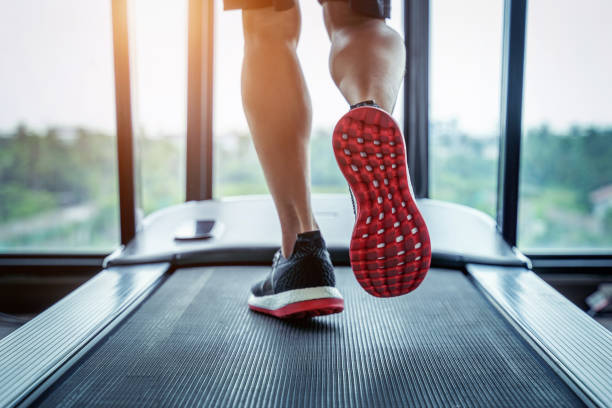
What is NEAT? Why is it more important than a treadmill?
Simply put, your daily calorie expenditure consists of three parts:
- Basal metabolic rate (BMR): Consumed for maintaining life (breathing, heartbeat), accounting for approximately 60-70%.
- The thermic effect of food (TEF): It accounts for about 10% of the energy consumed in digesting food.
- Activity-based energy expenditure: This is further divided into two categories—EAT (specific exercise, such as running) and NEAT (walking, leg shaking, doing housework, and standing).
The problem is that most people, in their quest to increase their basal metabolic rate, obsessively focus on the 5% EAT (Exercise Amount) while neglecting NEAT (Nutritional Absorption Amount), which can account for as much as 15%-50%.
When you sit in a chair, the electrical activity in your thigh muscles is almost zero, and calorie consumption is at its lowest. However, if you can switch from this 8-hour “resting mode” to “micro-movement mode,” the accumulated calorie deficit will be astonishing.
This is the core logic of the NEAT weight loss method: not relying on explosive sweating, but on a steady, continuous output.

Balance Board: Your Calorie-Burning Amplifier
At this point, you might ask, “Can’t I just work standing up?”
Standing is indeed better than sitting, but simply standing still can easily lead to varicose veins or postural fatigue. The Balance Board cleverly solves this problem and further improves the efficiency of burning calories while standing at work by 20%-30%.
1. The Magic of Micro-Stabilization
When you stand on a balance board, your body must make tiny adjustments several times per second to maintain balance.
- Your calf muscles (gastrocnemius, soleus) are constantly contracting.
- Your core muscles are forced to maintain tension to stabilize your spine.
- Your quadriceps are undergoing a slight flexion and extension.
These movements are so small that you won’t even feel yourself exercising or sweat. But physiologically, this kind of sustained low-intensity muscle contraction requires energy.
You’re like a sports car that hasn’t turned off at a traffic light and is instead lightly pressing the accelerator; the engine (metabolism) is constantly idling and burning energy.
2. Activate lipoprotein lipase (LPL)
Studies have shown that prolonged sitting inhibits the activity of lipoprotein lipase (LPL), an enzyme responsible for breaking down fat in the blood. The sustained lower limb activity provided by the balance board helps keep LPL active, preventing fat accumulation in the abdomen. This is not just a matter of calories, but also a matter of hormones and the metabolic environment.
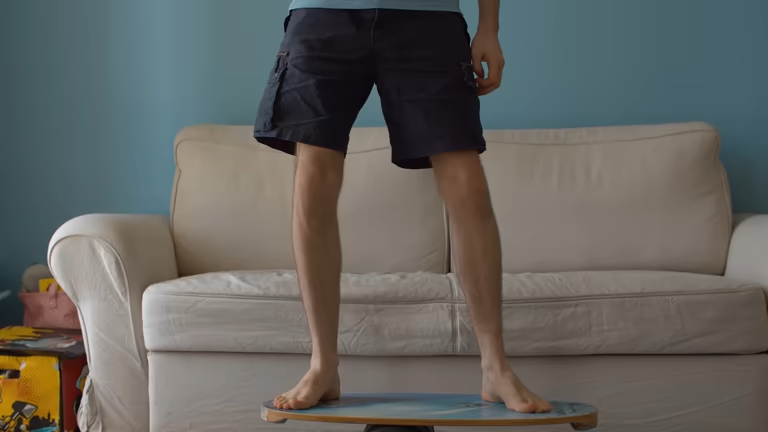
A Revolutionary Scenario: How to Transform “Laziness” into “Leanness”
No need to set aside specific time. The beauty of the Balance Board is that it can “integrate” into your existing lifestyle.
Scene 1: The Hidden Gym Under the Desk
If you have an adjustable desk, push the chair aside and replace it with a balance board.
Operation: No vigorous shaking is required. Simply spread your feet apart and feel the subtle shifts in your center of gravity.
Results: You’ll find that the drowsiness at 3 PM disappears. This is because the muscle pump promotes blood flow back to the brain, resulting in more oxygen supply. While you’re replying to emails, your body is silently burning calories.
Scenario 2: Netflix Companion
Watching TV shows at night is a typical “slacker time” for modern people. Try replacing the sofa with a balance board.
Operation: While watching TV, gently rock the board from side to side (rocking).
Effect: You are no longer a static object slumped on the sofa. After watching a 40-minute episode, you may have unknowingly burned 100-150 calories, equivalent to walking 2 kilometers briskly, but you don’t feel the pain of “I am exercising.”
Redefining “Movement”
If you hate the feeling of your lungs bursting while running or are terrified of the heavy weights in the gym, don’t blame yourself.
Humans aren’t genetically designed to run for an hour every day and then sit for 23 hours; they’re designed for low-intensity activity all day long.
The Balance Board isn’t meant to replace your barbell or running shoes; it’s a piece of the puzzle that fills a gap in your life. It returns the calories that were “stolen” from your chair to you.
Losing weight doesn’t have to be a battle full of sweat and pain. Sometimes, all it takes is for you to stand up and wiggle a little.
FAQ
Q1: Does using a balance board really burn significantly more calories than sitting?
According to estimates from the Mayo Clinic and multiple sports science studies, standing while working burns approximately 10-20 more calories per hour compared to sitting.
Standing on an unstable surface like a balance board, with greater muscle engagement, can burn approximately 40-50 more calories per hour than sitting.
Assuming you use this method for 3-4 hours daily, theoretically, this could result in burning an extra 30,000-50,000 calories per year, equivalent to 4-6 kilograms of pure fat.
Q2: Will working on the balance board be distracting?
For the first 1-2 days, your brain may need to allocate some attention to maintaining balance.
However, because the balance board’s movements are rhythmic, it quickly becomes an “unconscious competence,” like breathing.
In fact, many users have reported that the slight body swaying actually helps relieve anxiety and improve concentration (which aligns with sensory integration theory).
Q3: Is this NEAT weight loss method suitable for people with high body weight?
It’s perfect, even more so than running.
When heavier individuals run and jump, their knees experience immense pressure.
Balance boarding, on the other hand, is a zero-impact activity. It engages all the muscles in the body to promote metabolism without putting stress on the joints, making it an excellent way to increase basal metabolic rate.