Can maintaining balance on a balance board eliminate mental strain?

Is your brain too “noisy”?
Imagine this scenario: You’ve finished a long day and are lying exhausted on the sofa, trying to rest. But your brain doesn’t stop. Tomorrow’s meeting, a slip of the tongue from last month, unpaid bills… countless thoughts are flooding your mind like a barrage of comments.
This is what we often call mental exhaustion. Many people suggest “meditation.” So you sit cross-legged, close your eyes, and find that your brain, which was already a little noisy, becomes deafeningly loud in the silence. For modern people like us who are constantly under high pressure, stillness can sometimes be an amplifier of anxiety.
What if I told you that the best way to calm your mind is not to force your body to stop but to put your body on the edge of “danger”?
This is precisely the quiet revolution that Balance Board is bringing to the field of psychological healing. It is no longer just a core training tool; it is your physical “power off” button.
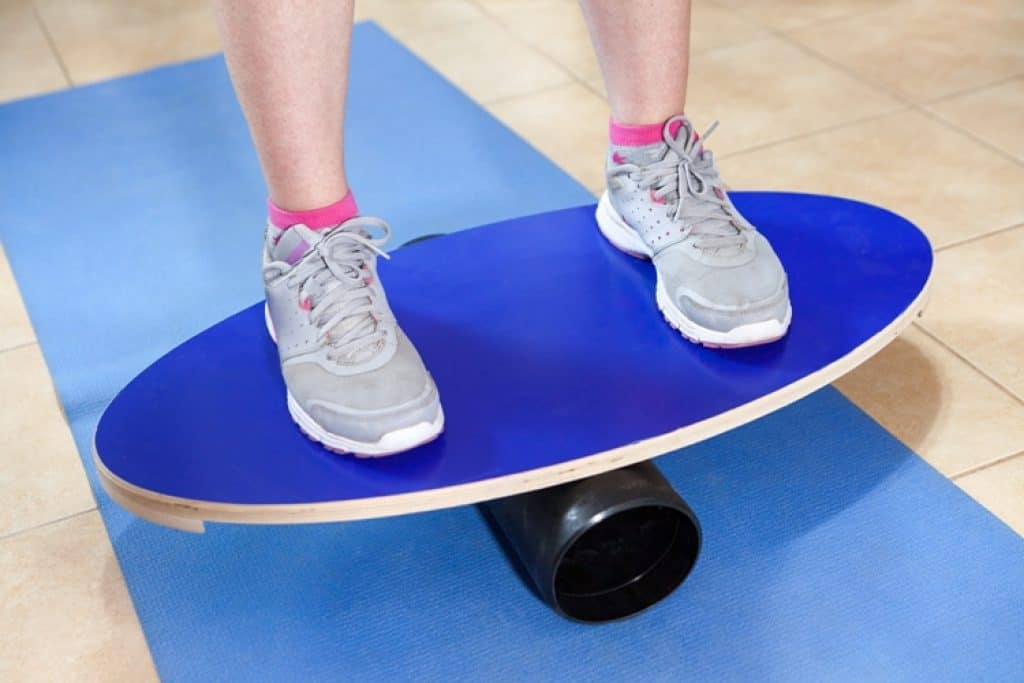
The neural mechanisms of compulsion: Why can’t you feel anxious when you fall?
When you’re on an unstable balance board, something amazing happens: your anxiety suddenly “shuts down.” This isn’t some kind of mysticism but rather is based on humanity’s most primal survival instinct.
1. Survival Priority
Your brain processes information with priorities. When your vestibular system (the organ responsible for balance) detects that your body is about to lose its balance, your brain immediately triggers “survival mode.” In this mode, keeping your body upright is the top priority.
Worries about the future (anxiety) and regrets about the past (depression) are considered “low-priority tasks” by the brain. To mobilize all neural resources to control muscle fine-tuning, the brain must filter out background noise. This is why the Balance Board is an extremely effective exercise for relieving anxiety—it physiologically forces you to shut out distracting thoughts.
2. Turn off the default mode network.
Neuroscience tells us that mental fatigue primarily stems from the overactivity of the brain’s Default Mode Network (DMN). High-intensity sensory input is an effective way to suppress the DMN. When you feel every millimeter of inclination on the board with the soles of your feet, this dense flow of information crowds out the bandwidth for random thoughts.
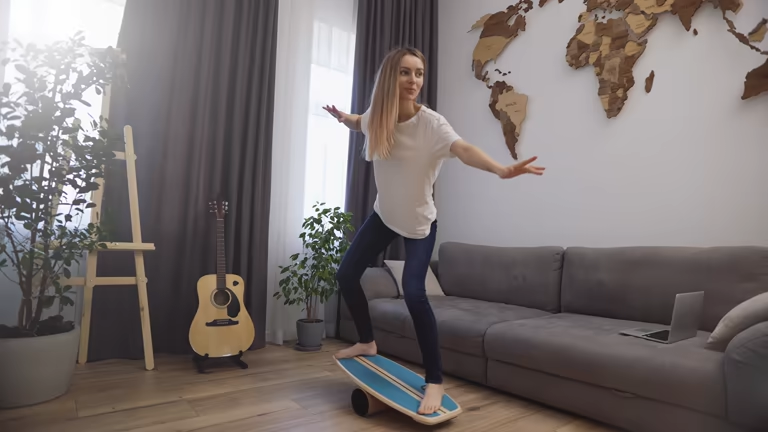
Dynamic Meditation: Finding “Flow” in Imbalance
You may have heard of “flow state”—that state of forgetting time and being completely absorbed in the moment. We usually think that only artists or extreme athletes can achieve this state. But in reality, the Balance Board offers a low-barrier entry point.
The “focus” here is different.
Unlike the tranquility gained from playing with coloring books or building with Lego bricks, the focus training provided by the Balance Board is holistic (embedded).
- LEGO/coloring: It is a cognitive level of focus, while the body remains still.
- Balance board: It’s about mind-body focus. Your breathing, your core muscles, and your toe grip must work together like an orchestra.
This is what’s known as Dynamic Meditation. You don’t need to consciously “think” about emptiness; you just need to focus on “not falling.” In this extreme focus, you experience a thrill similar to surfing or skiing, but you don’t need to drive hundreds of kilometers to the beach or snow-capped mountains; you just need to be in the middle of your living room.
Deep insight: On a balance board, you can never achieve “perfect stillness.” You are constantly adjusting dynamically between “leaning slightly to the left” and “pulling slightly back to the right. ” This is much like life itself—balance is not a static result but a dynamic process. Accepting this swaying often cures the desire to control others and the obsession with perfection.
How to start your “brain vacation”
If you want to use the balance board to combat mental fatigue, forget about fancy squats or acrobatic moves. Our goal isn’t to build muscle but to train your nerves.
1. Creating a sacred space
Turn off the TV and toss your phone into another room. Play some soft white noise or lo-fi music.
2. Establishing micro-connections
Stand on the board with your feet shoulder-width apart. Avoid swaying too much; try to keep the board level. Focus your attention on the center of your feet. Imagine your breath flowing like water down to the soles of your feet.
3. Observe, do not judge.
When you lose your balance (which you will inevitably do), don’t mentally berate yourself for being “clumsy.” Observe how your body loses its balance, and then observe how it regains it. This “observer’s perspective” exercise can greatly enhance emotional resilience.
If you’re looking for something that’s more than just a workout device but a sanctuary for your soul, we recommend choosing models with a warm, smooth feel and a simple design.
Find peace in the swaying
In this age of information overload, our brains are like a phone with too many background programs running—overheating and lagging. We’re constantly searching for ways to stop it, but often the opposite happens.
The Balance Board teaches us a simple truth: sometimes, to achieve inner peace, you need to get your body moving first. When you focus entirely on the plank beneath your feet, the world shrinks, anxiety disappears, and only the present moment and the path beneath your feet remain.
This may be the best antidote for modern people—in the midst of the swaying, we finally gained our footing.
FAQ
Q1: Which is better, this “dynamic meditation” or traditional seated meditation?
There is no absolute good or bad, only what suits you. For those who become restless and unable to sit still as soon as they close their eyes (usually high-anxiety individuals), dynamic meditation methods are often more effective. This is because the balance board provides concrete physical feedback points, giving their wandering attention a foothold. You can think of it as a prelude to or alternative to traditional seated meditation.
Q2: I have a very poor sense of balance. Will I be even more nervous standing on it?
This is a common concern for beginners. If you’re worried about falling, this fear can certainly increase stress. It’s recommended to start with the most basic “Rocker Board” (simply rocking from side to side, without wheels) or practice while holding onto a wall. The goal here isn’t to challenge yourself with high-difficulty exercises, but rather to practice and improve focus in a relatively controlled “micro-challenge” environment. A sense of security is a prerequisite for entering flow.
Q3: How long do I need to practice each day to relieve mental exhaustion?
It doesn’t need to be a long time. In fact, short “micro-breaks” are most effective. When you feel stressed at work and your mind is stuck, stand on a balance board and rock for 5-10 minutes. This anxiety-relieving exercise can quickly break the vicious cycle of rumination, allowing you to return to work with a clear mind.