
In the world of fitness, basic balance training is just the beginning. For experienced users, the key to true professionalism lies in how to push their limits, traverse the surface, incorporate weight training, and integrate dynamic jumps on a balance board . Imagine a slightly swaying board; each subtle body adjustment requires simultaneous engagement of the core, lower limbs, and scapular muscles—this is the unique charm of advanced balance training.

The core principles of advanced balance skills
Advanced balance training using a balance board goes beyond static support; it involves complex neuromuscular coordination and dynamic control. Through advanced balance board skills training, the body must maintain posture in unstable environments while responding to sudden disturbances. This continuous feedback mechanism strengthens the vestibular system and deep core muscles, thereby improving overall stability and athletic performance.
In practice, trainees progressively increase the inclination, frequency, and direction of the balance board, making each training session a multi-dimensional challenge. This method not only improves balance but also significantly enhances joint control and agility, laying the foundation for high-intensity functional training.
Cross-plane action and continuous challenges
True advanced training emphasizes cross-plane movements . In board challenge workouts , the alternation of forward/backward, left/right, and rotational movements activates more muscle groups and enhances neuromuscular adaptation. For example:
- Multi-directional balance steps : Alternately move forward and backward, left and right on the board, combined with core rotation, to form a full-body coordination training.
- Dynamic support transition : Quickly switch between standing on one leg or half-squatting postures to increase balance difficulty and strengthen lower limb muscle endurance.
- A series of continuous movements : tilting forward and backward + rotating left and right + twisting the core, forming a continuous challenge chain to improve heart rate and core stability.
Through this cross-plane training, users can not only improve muscle recruitment rates, but also maintain professional-level stability under high-intensity movements, fully demonstrating the training value of pro stability training .
Weight balance and strength integration
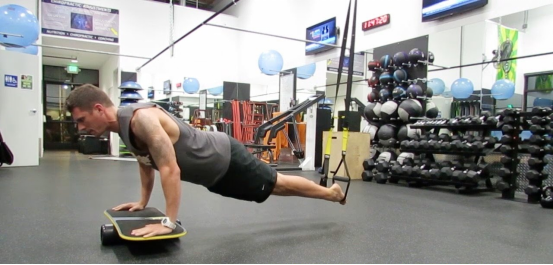
Once basic balance is stable, weight training becomes a crucial means of increasing the challenge level. Adding weight increases the difficulty of muscle control and also enhances joint stability. When performing weight training on a balance board , the core muscles need to maintain continuous contraction to resist external interference. For example:
- Dumbbell or kettlebell weighted single-leg balance : enhances lower limb and core muscle coordination.
- Bent-over rowing or press : Incorporate upper body strength training into dynamic balance to improve overall muscle strength and control.
- Continuous weight-bearing transition movements : Combine jumping or rotating movements to improve the neuromuscular coordination of the whole body.
This type of weight-bearing balance training not only increases muscle strength but also improves safety and control during high-intensity exercise, providing a more professional training path for advanced trainees.
Dynamic Jump and Explosive Power Challenge
Dynamic jumping and explosive movements are essential elements of advanced balance board training. Executing jumps on an unstable board requires coordinated contraction of all muscle groups, strengthening the core and lower limbs’ instantaneous power. This type of training not only improves balance but also significantly enhances athletic performance and neuromuscular reaction speed.
Typical training methods include:
- Small bounces on the board : bouncing forward and backward or side to side, strengthening the rapid muscle fiber response.
- Rotation and jump combination : Combines core twisting to achieve explosive cross-plane training.
- Continuous Jump Challenge : Jump multiple times in a short period of time while maintaining balance to improve endurance and control.
These movements stimulate the neuromuscular system at high frequencies, forming a coordinated training chain throughout the body, which enables trainees to improve their strength while also enhancing their dynamic balance.
Advanced training paths and gradual progression
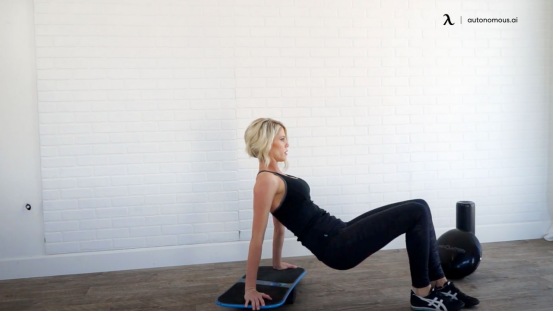
A complete advanced balance board training path emphasizes a gradual approach:
- Foundation consolidation : Ensure the static and balanced foundation is stable.
- Cross-plane integration : Introducing forward, backward, left, right, and rotational movements to improve muscle coordination.
- Weighted integration : Gradually increase the weight to strengthen core and lower limb coordination.
- Dynamic Jump Challenge : Integrates explosive power with continuous movements to improve neuromuscular response.
- Continuous task chain : Combine each link into high-intensity continuous training to enhance physical fitness and balance control.
A gradual approach not only ensures training safety but also maximizes training effectiveness, allowing experienced users to continuously gain a sense of challenge and accomplishment in pro stability training .
Practical Application
balance board training is equally feasible in gyms and at home . According to user feedback, combining cross-plane movements, weight training, and dynamic jumps 3-4 times per week for 6-8 weeks can significantly improve stability and muscle control. Trainees generally report that the complexity of the movement chain brings sustained focus, while the synergistic contraction experience of the core, lower limbs, and upper limbs is significantly better than traditional training.
Conclusion
Advanced balance board training is not only a challenge for muscle strength and stability, but also an enhancement of the body’s neuromuscular coordination. Through cross-plane movements, weighted balance, dynamic jumps, and continuous task chains, trainees can gain a highly professional control experience in each exercise.
Explore the full spectrum of balance board training to discover more professional training pathways. Make every balance workout not only a physical exercise, but also a cultivation of focus, agility, and control, helping you become a true balance master.