
Table of Contents
Don’t let the “bargain hunting” mentality ruin your ankles.
“Balance Board” on Amazon or Taobao might trigger a strong sense of cognitive dissonance:
On the left is a branded board priced at $129, and on the right is a “budget alternative” that looks almost identical but only costs $29.99.
Your brain—that rational financial manager—will immediately jump out to protest: “Wait a minute, isn’t this just a bent piece of wood and a cylinder? Why should I pay over a hundred dollars? This is an intelligence tax!”
I completely understand that skepticism. After all, they look identical in thumbnails.
But as an observer who has been in this industry for a decade, I must tell you a harsh truth: in the high-quality home fitness market, the price difference in balance boards is never just about brand premium but rather the distance between “safety red lines” and “industrial waste.”
When you stand on an extremely unstable roller 10 centimeters off the ground, every single molecular structure of the wooden board beneath your feet determines whether you’ll develop abs or end up in the orthopedic emergency room.
Today, we’re going to dissect the hidden costs involved and guide you away from the biggest pitfalls in this gym equipment shopper guide.
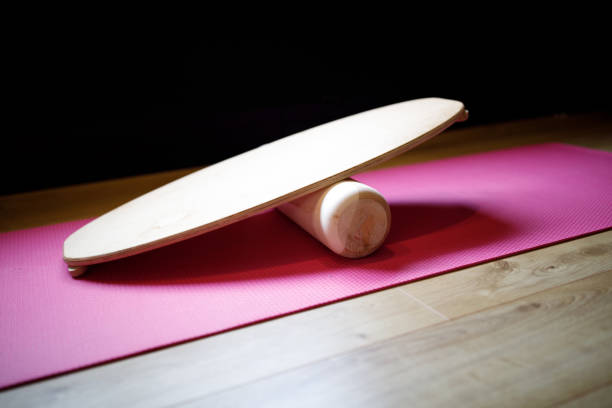
Core technology: Is it a “laminated structure” or “glue splicing”?
This is the primary reason why balance boards are so expensive.
The Hidden Dangers of Cheap Counterfeits: Breakage Anxiety
Most balance boards around $30, in order to cut costs, typically use ordinary softwood (such as pine) for simple glue splicing or even use furniture scraps directly.
Fatal flaw: The wood fibers are not reinforced. When you (assuming 70 kg) stand on one leg on the edge of the board, the leverage principle generates a huge shear force. The probability of a cheap board making a crisp snapping sound at that moment is surprisingly high.
Consequences: Imagine what would happen to your ankle if the board suddenly broke in two while you were in dynamic balance.
The confidence behind its $100+ price tag: Skateboard-grade pressing process
High-end balance boards are not as simple as “cutting a piece of wood.” They use the same multi-layer cold pressing technology as professional skateboards.
- Materials: Usually, 10-12 layers of high-hardness Canadian maple or birch are selected.
- Structure: Each layer of wood grain is cross-laminated and then subjected to hundreds of tons of high pressure for shaping.
- Value: This process gives the board amazing flexibility and load capacity. It can withstand impacts of over 300 pounds without breaking. The slight rebound and “vitality” you feel in the board is something that cheap plywood cannot imitate.
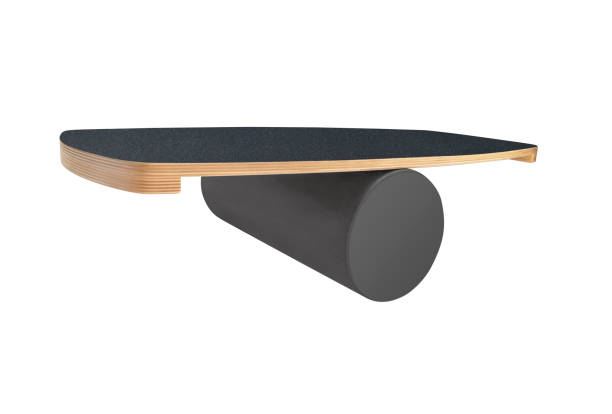
Contact surfaces: Not only non-slip but also “skin-protecting.”
The difference in the price of balance boards lies in the layer that your feet touch.
Cheap imitations: the brutality of industrial sandpaper
To prevent slipping, low-end products are usually directly sprayed with industrial-grade corundum.
- Experience: It feels as rough as 80-grit sandpaper. If you try barefoot training (which is the most recommended method), your feet will be blistered in less than 5 minutes. If you wear shoes, it will quickly wear down the rubber in your shoe soles.
- Shedding: After a few months, these sand particles will fall off everywhere like dandruff.
The confidence behind $100+: Micro-particles and composite materials
High-quality brands invest heavily in research and development of anti-slip treatments.
- Technology: They use finely calibrated grit (particle size) or employ a composite layer of high-density cork and EVA rubber.
- Value: This surface provides a sufficient coefficient of friction to prevent slipping even when you’re sweating, while also feeling smooth and gentle on the skin, making it extremely friendly for bare feet. This is why you can practice yoga on a high-end board, while on a cheap board it feels like stepping on broken glass.
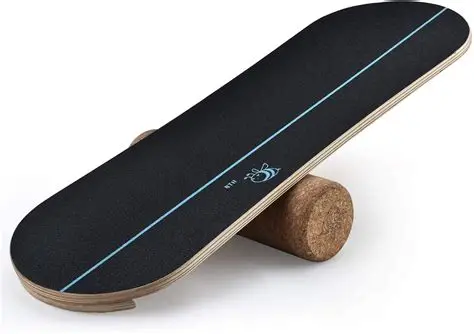
Roller: The Overlooked Safety Core
—theMost people only focus on the board but ignore the core component that makes it move – the rollers.
Cheap imitations: Disguised PVC water pipes
drainpipe.Many cheap rollers are essentially just a cut section of PVC drain pipe.
- Hidden danger 1 (deformation): The plastic wall is too thin and will become oval after bearing weight, causing it to get stuck when rolling.
- hardwood.Hazard 2 (Slippery): Hard plastic offers almost no grip on hard floors or hard wood. This can cause the so-called “shoot-out” phenomenon—the board flies off your feet like a bullet.
The confidence behind its $100+ price tag: Crack-resistant composite materials
High-endhigh-end balance boards are usually produced using custom molds.
- Material: Solid cork, high-strength composite rubber, or reinforced engineering plastic.
- .Value: They typically have a fabric texture or matte finish, providing just the right amount of rolling resistance . This resistance allows you to control your speed instead of sliding uncontrollably. Furthermore, they never deform, ensuring a smooth and rounded experience with every roll.
The unseen costs: environmental protection and chemical residues
Finally, don’t forget that you’re using it indoors.
The cheap wood products industry is a major source of formaldehyde exceeding safe levels. To bond inferior wood chips, factories often use large quantities of cheap urea-formaldehyde resin glue. When you open that $30 package, the pungent odor that hits you is a warning sign from your body.
Branded boards priced at $100+ typically use environmentally friendly low-VOC (low volatile organic compound) varnishes and non-toxic adhesives. This level of safety is invaluable, especially for families with pets and children.
Purchase advice: If you have a limited budget, it’s better to buy a used brand-name balance board than a brand-new, cheap imitation. In the balance board category, the laws of physics apply immediately and painfully to shoddy workmanship.
This is a one-time investment, not a consumable.
break, andThink long-term. A high-quality balance board is like a cast iron pot; as long as it’s not lost, it can almost be passed down to the next generation. It won’t go out of style, it won’t break, it will only become more refined with age.
When you choose a cheap product to save $70, you’re not just buying inferior materials but also the risk of sports injuries, a poor training experience, and the frustration of eventually having to throw it away.
When it comes to investing in health, the most expensive thing is often not buying the best but buying the wrong thing.
FAQ
Q1: Can I buy a PVC pipe and wood planks at a building materials market and do it myself?
Theoretically possible, but strongly discouraged.
The biggest problem with DIY is the inability to control the roundness of the rollers and the strength of the wood. Ordinary shellboard is not laminated and is very prone to breaking at stress points.
PVC pipes are too smooth and can easily cause falls and injuries. Unless you are a professional carpenter with knowledge of structural mechanics, the medical risks of DIY far outweigh the money saved.
Q2: Can people with lighter weight (e.g., 50 kg) use cheaper boards?
While lighter weight reduces the risk of breakage, the slippery wheels of inexpensive boards are the same for users of any weight. Furthermore, the rough finish of inexpensive boards can still damage your skin or floor. For a good, high-quality home fitness experience, an entry-level brand-name board is the bare minimum.
Q3: Why do some balance boards sell for $200 or even more?
Balance boards priced above $150 typically offer more than just basic safety features; they prioritize aesthetic design and special features.
These might include rare, high-quality wood veneers, handcrafted artistic designs, or unique 3D swaying structures.
If you’re looking for a home décor or a more advanced surf simulation experience, these higher-priced boards are worth the money. However, for basic training, the $100-$130 range is usually the sweet spot for the best value.