Why do professional athletes use balance boards as a basic training tool rather than as supplementary equipment?

At the sports field, you might have seen scenes like these: sprinters standing on wobbly planks to maintain a static stance before a race; skiers practicing lateral stability on a balance board after training instead of returning to their dorms; even NBA players doing dynamic balance exercises with their eyes fixed straight ahead and their feet slightly trembling after stretching in the locker room. There are no fancy moves, no piles of equipment; sometimes they simply stare at the ground, as if they are resisting some invisible force.
Isn’t it strange? Why would such a simple training tool be considered a basic tool by professional players, rather than a toy used by casual players?
If you think that a balance board is just a tool for beginners to practice balance or for “burning fat and sweating” in fitness classes, then you may be missing its true value. In the competitive sports system, this seemingly unassuming board is more like the underlying driver of athletic performance—it’s not icing on the cake, but rather a fundamental part of training, helping athletes correct movement flaws and improve their physical reactions and neural control.
This article delves into the fundamental logic of athletic performance and injury prevention, dissecting the three key values of balance board athlete training: neural reaction efficiency, stability and joint control, and motion quality reconstruction. After reading this, you may gain a renewed understanding of a crucial fact—basic training is never optional; rather, it is the foundational brick of the entire athletic performance pyramid.
The Hidden Contradictions in Competitive Sports: Strength Does Not Guarantee Stability
The strength of top athletes is beyond doubt; they can jump higher, sprint faster, and lift heavier loads. However, maximum strength does not equate to the most stable movement. Numerous sports medicine data indicate that most sports injuries do not occur at the peak of power output, but rather during the “transition moment”—the millisecond-scale movements involving acceleration and turning, landing and shock absorption, resistance and force application, and fine-tuning of body displacement.
You may have heard that the ACL doesn’t tear during a jump but rather at the moment of landing due to uncoordinated hip, knee, and ankle movements.
This is the significance of the balance board. It pushes the body into a controlled but constantly changing environment, allowing the deep stabilizing muscles, nervous system, and movement patterns to realign. Unlike stable ground, it doesn’t wait for the athlete to be ready before starting the movement; instead, it continuously provides disturbances, forcing the body to quickly assess, adjust, and correct.
This is a skill that strength training cannot replace: reaction, not force.
control, not brute force.
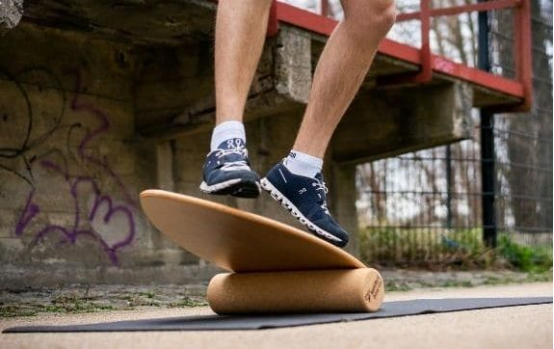
Why is the balance board considered a “basic training tool”?
Compared to the seemingly more “advanced” weight equipment in the gym, professional athletes use balance boards at the beginning of their training cycle—before strength training, before specific training sessions, during the season recovery phase, and during post-operative rehabilitation. The reason is simple: all high-level athletic skills are built upon stability and movement control.
Let’s break it down into three dimensions.
The nervous system is like an operating system, and the balance board is used to upgrade it.
Balance board Athlete training isn’t about building muscle; it’s about training the brain. More precisely, it’s about training the efficiency of communication between the brain and the nervous system. The moment you step onto the board, every subtle sway of your body is the result of the nervous system sending signals, the muscles receiving commands, and the joints reacting. There’s no pause button; one wrong beat and you fall.
In professional training, this is called “sensory-reaction speed.” It determines whether an athlete can make the correct movements in chaotic situations, such as making a slight adjustment to dodge a tackle in rugby or judging the angle of a skateboard landing solely by the feel of the sole of their foot.
Real-world examples are more convincing:
- Some NFL teams have incorporated balance boards into their pre-game activation routines to improve reflexes.
- WSL surfers undergo long-term balance training to reduce the risk of injury from unstable landings.
- The strength coach of the national climbing team publicly stated that balance training not only enhances lower limb control but also improves route planning and motion perception.
This isn’t about “getting stronger”; it’s about “getting faster, more accurate, and smarter.”
Like switching to a low-latency network, the entire process runs much smoother.
Deep stabilization system and injury prevention: The chassis that truly determines athletic lifespan
Strength can be increased with weights, explosiveness can be trained with sprinting, and flexibility can be improved through stretching, but stability and joint control must be honed in uncertain environments. The balance board is like a “lightweight version of the chaotic environment” that simulates the ever-changing real-world competition.
Imagine a typical movement: jumping, landing, and cushioning.
If the ankle slightly protrudes upon landing, and the hip does not correct this in time, the knee joint will bear the shear force alone; more than that, and it becomes a case in the medical imaging room.
Why do professional athletes emphasize balance training? The reason is simple and harsh:
No matter how talented the athlete is, they are still afraid of injury.
A review of studies shows that athletes who undergo long-term balance board sports performance training have a significantly lower rate of recurrent ankle sprains than those who do not engage in balance training. This is especially true in skiing, soccer, and tennis—those seemingly stable landings are actually the result of thousands of neuromuscular coordination movements.
The training objective here is not to “stand firm,” but to “stabilize momentary instability.”
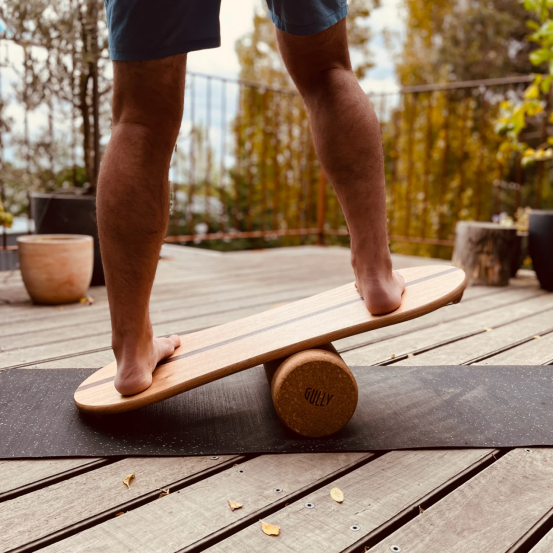
Action pattern reconstruction: The balance board acts like a mirror.
Many problems with exercise habits are not due to a lack of technique but rather a lack of proper movement patterns. For example, not being able to keep the knees closed during squats, poor hip control while running, and knees buckling inward after landing from a shot—these issues cannot be resolved by simply increasing strength, because the root cause is that the body does not know how to coordinate.
When standing on an unstable board, the body can’t cheat. Any compensatory movements will immediately become apparent: excessive toe grip, insufficient hip external rotation, inability to maintain tension in the abdomen, and loss of control over the chest and lower back angle. Athletes must learn to counteract instability with better posture. With enough repetitions, the brain will write this “correct pattern” into the default program.
It was like reflashing the firmware.
Once they were back on the ground, everything became much easier.
This is why the balance board isn’t considered “auxiliary” but “fundamental.” It doesn’t enhance strength; it cleans up gaps in movement, paving the way for specialized training. Just as a musician practices rhythm before fingering, its significance lies in returning to the essence.
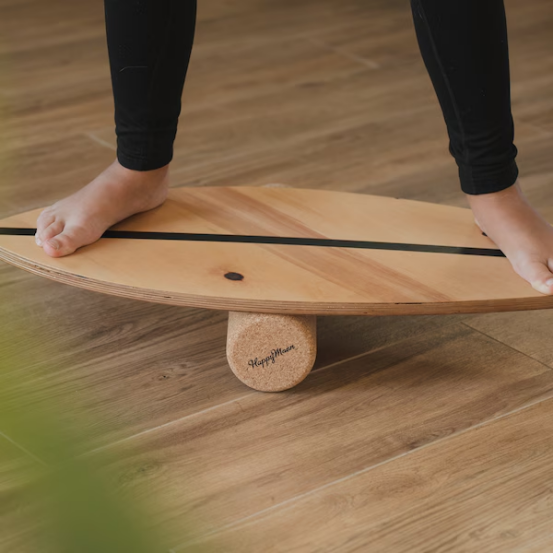
Training Examples and Implications of Professional Athletes
From publicly available training case studies and sports team sharing, we can see a trend: balance training for athletes is frequently used for four types of goals:
- Pre-match activation: getting the nervous system into a high-speed response state;
- Post-injury recovery period: Avoid excessive stress too early, and rebuild signaling pathways through controlled stimulation;
- Technical consolidation period: Skiers and surfers use it to train core stability and lower limb fine-tuning.
- Post-season recovery: Maintain joint mobility and basic control through low-impact methods.
training, but this is not a replacement for professional training, but rather like patching the underlying structure of the competitive system to prevent it from collapsing under high-speed operation.
balance boards in athletic performance. HYPERLINK “https://buybalanceboard.com/blog”, head over here for more professional training analysis and a more systematic breakdown of training methods.
When you re-understand the fundamentals, the balance board becomes something extraordinary.
Professional athletes are willing to dedicate time to balance board training within their hundreds of thousands of training cycles, not because it’s trendy, but because it’s effective. It doesn’t solve obvious problems but rather deep, hidden issues that determine the upper limit of performance.
The basics are not the lower level but the gateway to the higher level.
When you have a solid foundation in balance, neural reaction, motor control, and joint stability, there will be room for you to continue to improve your speed, strength, explosiveness, and skills.
Perhaps a more worthwhile question to consider is
When was the last time you seriously trained your “control”?
Are you willing to solidify your foundation before pursuing power?
If professional athletes are all returning to the balance board path, what reason do we have to skip the basics?