
In the yoga room at dawn, the floor is sculpted by sunlight, and a balance board lies quietly in the center. It looks simple and light, as if anyone could stand on it at any time and perform flexible and fluid movements. Perhaps you’ve also seen many people on social media platforms showcasing their high-speed twists, one-legged balances, and blindfolded challenges, as if completing a game without any cost.
However, balance training is not as easy as a “wobbly skateboard.” Especially when the balance board is misused or manipulated by training methods aimed at quick results, it ceases to be a tool for improving core strength and becomes a silent “warning flash.” Joint pressure imbalance, ankle ligament strains, and even long-term postural deviations often do not occur at the moment of a fall but rather begin with improper muscle coordination and compensatory movements, accumulating silently and gradually.
This article will take a risk control approach, breaking down the real consequences of misusing a balance board, exploring common misconceptions, explaining how the body structure withstands stress, and showing why professional guidance and progressive training can determine whether you “progress” or “mortgage your future” in sports.
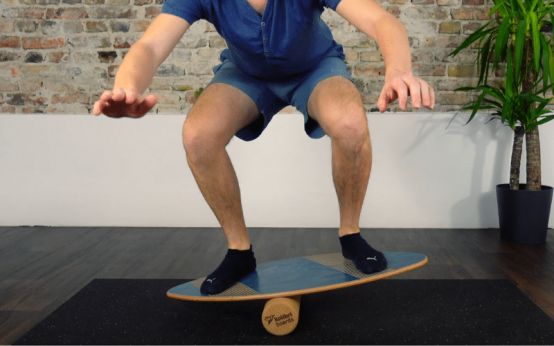
The first consequence of misusing the balance board: joints are forced to do excessive work.
The most common mistake comes from “exerting excessive force in order to stand firm.”
Toes grip the ground, knees are valgus, and thighs externally rotate—the body constantly compensates in subtle movements to maintain balance. When beginners lack proper posture or core engagement, individual joints bear excessive stress, especially the ankles and knees. Studies show that ankle eversion force can instantly increase to two to three times the normal walking force during unstable training. When posture is incorrect or when forcibly stopping, the lateral ligaments act as the first line of defense.
The pain will not appear immediately.
long.” It’s more like a slow accumulation—at first, it’s just soreness after training, then slight discomfort when bending and stretching, and later, a faint stinging pain when jumping or going down stairs begins to remind you that some parts have been “held for too long.”
Typical symptoms caused by incorrect use of the balance board include:
- Knee valgus leads to an imbalance in the strength of the quadriceps and gluteus medius muscles.
- Ankle eversion, ligament fatigue stretching
- Decreased dynamic stability of the hip joint
- Using the lower back to generate force can lead to increased pressure on the lumbar spine over time.
sensationalism but This is not sensationalism but a chain reaction already proven by numerous gym cases. As long as postural errors exist, the body is quietly reshaping incorrect patterns.
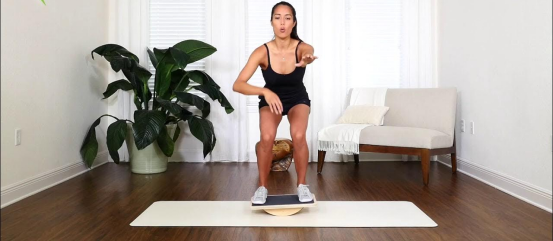
When the nervous system is over-challenged, reflex mechanisms begin to be sluggish.
Balance board training is not simply about training muscle strength; it also has a strong neurological response component. Each swing requires instantaneous communication between the brain, nervous system, and deep muscle groups. If the movements are too fast or the difficulty exceeds the user’s capabilities, the brain will experience a reflex delay, and information transmission will be stuck like a traffic jam.
Many users believe they can “stand by feeling,” but they overlook the fact that it takes time for the nervous system to establish stable control. When beginners directly attempt difficult movements—such as standing on one leg, training with their eyes closed, incorporating squats, or even jumping—the brain’s motor strategies are not yet ready, the body is still guessing how to maintain dynamic balance, and incorrect signals begin to accumulate.
Balance board risks are not only reflected in falls but also in long-term nervous fatigue:
- Reaction speed decreases, and it becomes increasingly difficult to concentrate the longer the training continues.
- Neuromuscular recruitment is confused, and the body mistakenly believes that “the wrong posture is correct.”
- Compensatory exertion becomes a habit, ultimately reducing training efficiency.
- Core engagement decreases, while pressure on the lower back continues to increase.
You’ll feel your movements becoming increasingly unresponsive.
It’s not that the balance board is difficult; the difficulty lies in your body not having the correct learning methods.
Posture breakdown doesn’t happen instantaneously; it’s caused by neglecting details during training.
A worrying phenomenon is that many people, when standing on a balance board, act like a taut rope, straining from their shoulders and spine to their pelvis and ankles. But true balance training isn’t about “holding your ground” but about allowing subtle adjustments to occur naturally.
When shoulders are shrugged, the spine is stiff, and the pelvis tilts forward, the body becomes like a tower that could topple at any moment. Adding movements at this point, such as squats or stretches, results in joint angles and loads outside the healthy range, and wear and tear begins invisibly. Long-term incorrect training can cause:
- Forward head posture, rounded shoulders
- Pelvic misalignment leads to gait changes.
- Persistent tension in the lower back muscles can even lead to chronic lower back pain.
- Uneven distribution of lower body strength: one leg gets stronger with training, while the other lags behind.
Many people feel nothing when walking on flat ground until their knees inexplicably ache during their last balance board exercise, at which point they ask why, but it’s too late.
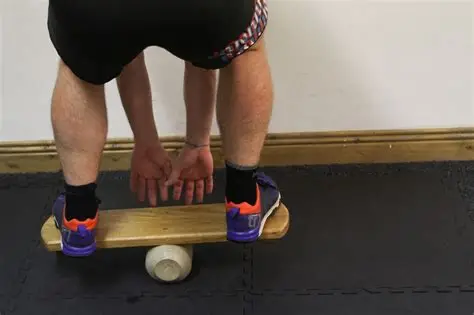
Why is it necessary to use the correct posture and train step by step, rather than blindly challenging oneself?
The fundamental problem with incorrect use of the balance board is not that the movement is difficult, but that the training lacks structure.
The body needs to build its neural circuits and strength foundation step by step, from static stability to dynamic stability to weight control to advanced movements, rather than leaping directly to advanced movements.
Proper training typically involves three key steps:
- Establishing ankle and foot sensation, including posture adjustment, arch engagement, and avoiding toe gripping.
- Core engagement and synchronized breathing: Activate deep abdominal muscles, rather than relying on leg support.
- Rhythm training, not speed training: slow, steady, and light are the true ways to develop balance.
Only when each stage is solidly advanced can the balance board become a powerful tool for training neural control, improving posture, and enhancing athletic performance, rather than a source of injury.
The consequence of misuse is not intimidation, but rather the development of a more mature understanding of risk.
Balance boards are inherently safe and fun, and their role in core stability, balance development, and sports rehabilitation is highly recognized in many fields of physical therapy and sports training. However, any platform with inherent instability follows the same principle: correct use leads to progress, while incorrect use results in compensation.
Risk isn’t meant to discourage you but to help you gain a clearer understanding of the science behind training.
When we understand why our knees hurt, why our ankles are prone to twisting, and how our posture is gradually affected, we understand the importance of professional guidance and training structure.
Balance training isn’t just about aesthetics; it’s a learning process that involves the body and brain working together.
The more careful you are, the faster you progress.
The more you respect your body’s feedback, the more meaningful your training becomes.
End
The next time you step onto the balance board, try going slower and more steadily, allowing your body to truly learn rather than rushing into it. Remember, the true value of exercise lies not in showing off techniques, but in long-term, steady improvement. If you want to avoid these hidden risks or wish to build a more scientific training path, consider reading our in-depth analysis and finding the answers you need in our balance board-related topics.
Are you willing to move from simply “standing on” to “truly being able to use” it?
Perhaps this will be the starting point for your balance training transformation.