
Table of Contents
Reclining chairs, lying flat, prolonged sitting—once our bodies are “supported” too easily, we forget that the human body wasn’t designed for stillness.
What truly brings the body to life are those imperceptible swaying movements, the changes in angle between the soles of our feet and the ground, and the subtle adjustments our core makes without us even realizing it. And the moment you step onto a balance board, these neglected sensations reconnect like an electric current.
It’s not simply about standing still and completing the movement but about feeling how the body finds balance in the face of imbalance.
This is the core of our discussion today: how the balance board can reshape body awareness, transforming training from performing movements to understanding the body.
In the past, the understanding of training was mostly limited to “training strength, speed, and improving stability.” However, more and more research and sports performance trends are proving that proprioception, body awareness, and the motion feedback system are the underlying key factors that determine:
- Agility
- Reaction mechanism
- Joint protection ability
And the balance board happens to address this underlying issue. Next, let’s break down the process of “sensory upgrade” and see what changes occur between the body and brain the moment the feet step onto the wooden board.

The Body’s Silent Negotiation
You may think you’re standing, but your body is actually constantly “negotiating.”
A balance board won’t give you stability; it only provides unpredictable feedback that you might slip off at any moment. And that’s precisely where the training value begins. The soles of your feet tilt slightly, your ankles reflexively tighten, your core muscles automatically adjust, and your spine tries to stay vertical. Your body doesn’t wait for you to think; it moves first.
This is how the proprioceptive system works. Unlike vision, it’s not immediately obvious, yet it silently influences every movement—you can touch your nose even with your eyes closed, not because you see it, but because your body is aware of its position.
The balance board is amplifying this process. You can clearly feel it:
- Every slight loss of balance is a reminder that “your body is here.”
- The brain begins processing rapid signals from the soles of the feet, ankles, and knees.
- The focus shifts from the surface of the movement to the internal workings of the body.
Many surfers, skateboarders, and snowboarders have similar experiences: standing on the board isn’t just about “standing still,” but about constantly engaging in a dialogue with your center of gravity. This isn’t just superficial balance training; it’s more like a process of awakening the mind and body through balance training.
When the feet begin to understand that “the ground is not fixed,” the brain begins to upgrade its movement strategies.
Perception vs. Strength: The Intelligence Upgrade
Strength can be increased by carrying weight, but body awareness can only be truly awakened in unstable environments. This is the unique value of the body awareness training balance board.
Neuromuscular science research indicates that when the exercise environment is unstable, the body increases its sensory acuity and quickly establishes new motor circuits to avoid falls or injuries.
Consistent training makes you stronger; unstable training makes you smarter.
These two things seem to move in the same direction, but they act on completely different aspects of the body. On the balance board, you will go through a phase like this:
The Learning Curve of Awareness
| Phase | Physical Experience | Internal State |
|---|---|---|
| Phase 1 | Movements become clumsy | System panic / Initial recalibration |
| Phase 2 | Muscle involvement increases | Active searching for balance |
| Phase 3 | Anticipate your body’s reactions | Reflexive “Dialogue” established |
At that moment, you’ll realize that your body isn’t passively executing commands but actively making judgments. This intelligent motor ability is key to improving the performance of many athletes, and it’s also the fundamental guarantee for ordinary people to avoid sprains, ankle twists, and other problems.
More importantly, you begin to feel the details of your body, such as
- Is the arch of the foot collapsed?
- Should the core tighten in advance?
- Is the knee excessively valgus?
- Is your breathing in sync?
Once this awareness is established, it will transfer to daily life and exercise. Walking, running, climbing stairs, and even lifting heavy objects will become more effortless. This is not simply a change in strength but an upgrade of the “built-in protective system.”
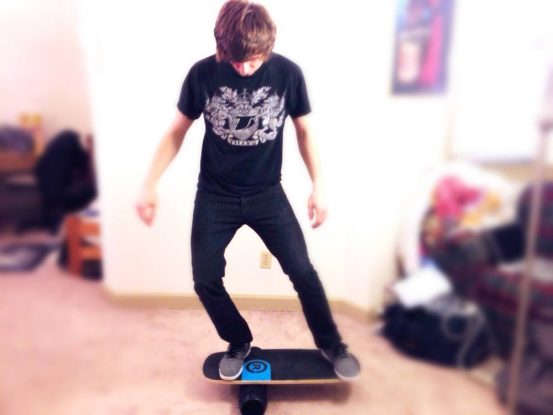
Feedback System Back Online: Stopping the “Autopilot”
We are used to navigating the world with our vision, but we forget that the precision of our movements depends on an internal feedback system. Proprioception acts like a silent sensor, providing real-time information about the body’s position and angle.
Many people are surprised when they first encounter balance board proprioception training: they thought they were well-coordinated, but they started to sway after standing for less than ten seconds.
This is not weakness but rather a state of dormancy in perception.
As you continue training, your brain will actively create new sensory circuits:
- The brain receives signals 2. Processes posture 3. Muscles perform fine-tuning 4. Generates faster feedback
This cycle occurs dozens or even hundreds of times per second. The more you practice, the faster it becomes more natural, eventually leading to a state where you can do it correctly without even thinking.
This is what many skateboarding, yoga, and fitness enthusiasts refer to as—
- Suddenly, the movements “flowed smoothly.” * The center of gravity seemed to automatically align.
- The body became lighter.
- And even during exercise, there was an intuitive feeling of “sounds closer to the body’s true nature.”
It’s not metaphysics but rather a scientific concept of heightened motor feedback.

The True Evolution: From Task to Experience
The most fascinating thing about Balance Board is never that it looks cool, but that it makes people realize that the body is far more complex, more vibrant, and more worthy of exploration than the movements presented on camera.
When you maintain your balance on the board, the focus shifts from the outside to the inside. Your attention is no longer just on “standing firm,” but rather:
- Is my weight on the inside or outside of my feet?
- Is my breathing synchronized with the rhythm of the movement?
- Is my lumbar spine compensating?
- Is the muscle activation sequence correct?
- Is the pressure of my feet hitting the ground even?
Every moment of awareness is a profound dialogue. The training gradually evolves into a “body philosophy”:
- It’s not about pursuing perfect execution of movements, but about understanding why those movements work;
- It’s not about staring in the mirror to correct your posture but about letting your body find the answers on its own.
This is the “perceptual upgrade” brought about by the balance board.
End
Balance board isn’t about teaching you how to stand on a board but about teaching you how to rediscover yourself.
From the feet to the brain, from reflexes to judgment, from completing actions to understanding actions, this is the true path of bodily evolution. When you begin to notice those tiny, subtle, and previously overlooked bodily signals, training is no longer repetition but exploration.
If you would like to delve deeper into advanced topics such as balance training, movement stability, and proprioception improvement, you can continue reading our extended articles or check out the balance board content to learn more about training ideas and applications.
Perhaps, the next time you step onto that unstable plank, you’ll find that your body hasn’t become stronger but rather “smarter.”
Would you try standing up again with your eyes closed? What keeps you from falling? The answer lies inside your body.