How to Rebuild Core Control Balance Board Through Long-term Unstable Training

balance orThe most amazing training isn’t taking photos after a good sweat, but rather the moment you almost slip on the stairs and instinctively regain your balance; or when your abs automatically activate like a switch during a turn while running, pulling you back to your midline.
mirror butThat sense of “stability” we call “stability” isn’t the clearly defined abs in the gym mirror, but the result of a deep system relearning how to function. And if training shifts from stable surfaces to unstable ones, especially a balance board, the changes will be quieter and more profound than most people imagine, yet long-term and difficult to reverse.
Many people expect balance boards to deliver fat burning, body sculpting, and cool moves, but their true core value lies in the underlying neural control and movement pattern reconstruction.
Long-term training isn’t about increasing strength; it’s more like installing a new operating system for the body. Muscles are merely the execution end, while the decision-making end is the nervous system.
Next, let’s break it down from three angles to see how the balance board reshapes a more stable and agile body through daily, small challenges:
- Neural circuit remodeling
- Deep core activation
- Movement pattern reprogramming
1. Neural Control Upgrade: From “Exertion” to “Response”
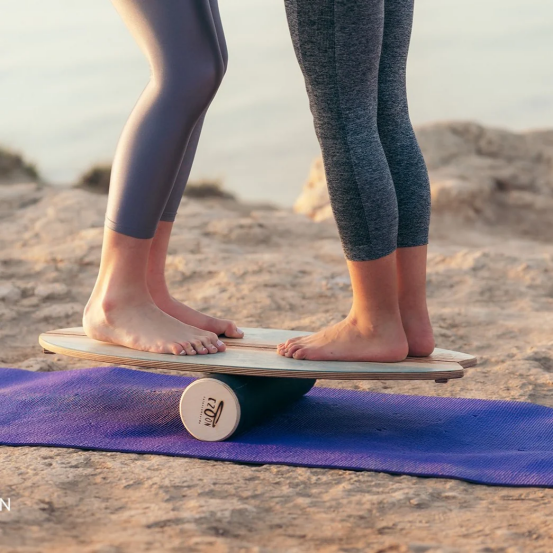
The moment you place your foot on the balance board, your brain doesn’t receive the message “exercise,” but rather “the need for more precise control.” The ground is shaking, but what truly moves the fastest are the nerve signals.
Studies show that training on unstable surfaces can enhance proprioceptive balance training, making position receptors in the feet, ankles, knees, and even the spine more sensitive. The brain begins to react based on shorter reflex paths rather than conscious commands.
- season,Real-world Example: Some skiers train with boards before the season not for strength, but to improve their reaction speed and posture adjustment.
- Analogy: This change is often subtle, like suddenly typing faster on a keyboard; you’re not training your finger strength, your brain has simply learned the shortest path.
Counterintuitively, balance board training doesn’t lead to “more effort,” but rather “less effort.” Control becomes more precise, and movements consume less energy. Unstable training allows the nervous system to continuously learn through small-scale postural adjustments, similar to constantly tuning a system, making movements more automated.
Over time, the body performs more gracefully in:
- Crowded subways
- Slippery surfaces
- Sudden stops and turns on the sports field
This isn’t a change you can see in the gym mirror, but it often determines the safety and efficiency of your movements.
2. Deep Core Activation: Not Just Using Your Abdominal Muscles, but “Deep Locking”
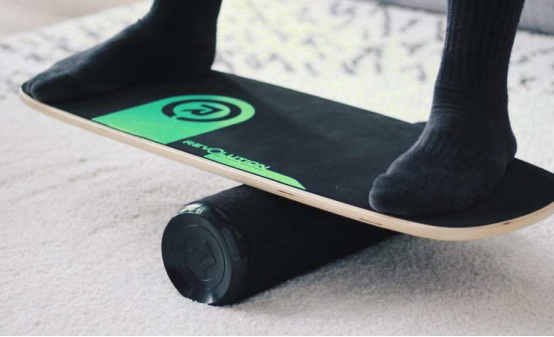
Many people feel a burning sensation in their abs after doing a plank for one minute and think they’ve completed their core training. However, a true core isn’t just about the six-pack abs; it’s a multi-layered structure that works together to stabilize the spine. Long-term use of a balance board is more like awakening those small muscle groups that are usually neglected.
Core Mechanism Comparison
| Aspect | Traditional Stable Training | Unstable Balance Board Training |
|---|---|---|
| Primary Target | Superficial muscles (e.g., Rectus Abdominis) | Deep stabilizers (Transverse abdominis, multifidus) |
| Activation Method | Weight/Resistance stimulation | Controlled instability challenges |
| Mental Effort | Conscious contraction | Automatic/Reflexive engagement |
| Functional Result | Muscle definition | Spinal protection & “Deep Locking” |
stimulation butAs the body constantly searches for balance on the board, with each slight sway, the transverse abdominis, multifidus, and pelvic floor muscles are automatically engaged without you even having to think about them. Deep core strength isn’t activated by weight stimulation, but by controlled challenges. Unstable training naturally brings these muscles from the “backstage” to the “foreground.”
Experienced physical therapists will point out that many cases of chronic lower back pain are not due to weakness, but rather because the core is not “taking over” on time.
core:Instability training acts like a reminder to the core, “You need to get back to work.” When the journey is long enough, the core is no longer a “training program,” but rather an automatically activated background process that protects your spine from lifting objects, prolonged sitting, and the impact of exercise.
This is more important than abdominal muscle definition because it affects whether you can use your body painlessly for a long time.
3. Motor Pattern Reconstruction: The Body Relearns “How to Cooperate”
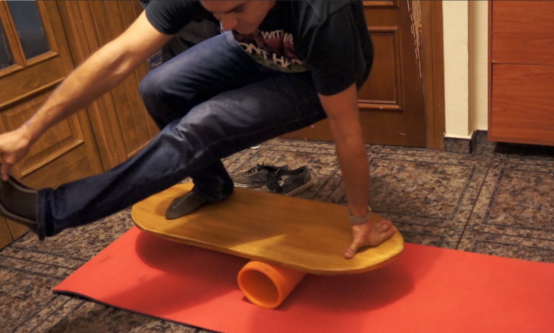
Long-term balance board training will produce a third layer of change—the transfer of movement patterns.
strength butMany athletic performance improvements aren’t due to greater strength, but rather to improved coordination.
- legs butSkateboarders: Smoother turns aren’t because of stronger legs, but because “the body understands how to go with the flow.”
- Diverse Applications: Surfers, yoga practitioners, rock climbers, and even badminton players are also working on this feeling.
It’s not about increasing the strength of a single joint, but about the feet, hips, core, and shoulder girdle working like gears.
You’ll start to notice that seemingly unrelated movements suddenly become smoother:
- Squats are more stable.
- Arm swings while running are more coordinated.
- Changing positions while sitting in an office chair won’t cause lower back strain.
This is because the balance board not only trains the body but also trains “inertial path selection.” The brain will choose more economical, stable, and coherent movement strategies. This is why long-term users often say, “The movements feel more natural.”
overnight butThe reconstruction of movement patterns does not happen overnight, but is the result of small adjustments made every few minutes or millimeters each day.
Long-term Transfer Value: A System Upgrade
If traditional training is like temporarily injecting strength into the body, then a balance board is more like updating the underlying code of an operating system. Strength will decline, but neural control and pattern reconstruction will leave a deep imprint. The benefits of training are reflected in everyday life and athletic performance, not just in the mirror.
You might not notice the exact moment the changes occur, but you’ll:
- Automatically steady yourself when you trip unexpectedly.
- Experience no sharp pain in your lower back when turning to lift something.
- Maintain a light and agile posture during long runs.
These changes aren’t as immediately apparent as shiny skin or defined muscles, but they impact your physical sustainability for the next decade.
If you are exploring more techniques, advanced exercises, and movement structures related to unstable training, you can visit the Balance Board page for in-depth content to make your training approach more complete.
Summarize
faster butThe long-term value of balance board training lies not in making you sweat faster, but in reshaping how your body responds to the world. Through upgraded neural control, deep core activation, and reconstructed movement patterns, this type of unstable training subtly alters the quality of your movements, making you more stable and efficient in daily life, competitive sports, and unexpected situations.
styling butThe core isn’t strengthened but reconnected to the system. Training isn’t about styling, but about refreshing your capabilities.
weight butPerhaps the next real breakthrough isn’t about increasing training weight, but about enabling the body to relearn how to sense, adjust, and coordinate. From the moment you step onto the balance board, the change has already begun.
Would you be willing to give your body such a long-term renewal? If the answer is yes, then next time you train, you might as well start with “instability beneath stability.”