
When your body sways slightly on an unstable surface, have you ever wondered how this seemingly simple movement profoundly affects core strength, neuromuscular coordination, and overall athletic performance? A balance board is more than just a tool for training balance; it activates the deepest muscle groups and sensory systems, thereby improving body control and reaction speed in both static and dynamic environments. Understanding its scientific mechanisms can help sports enthusiasts, rehabilitation patients, and general fitness enthusiasts maximize their training benefits.
The Role of Balance Training in the Vestibular System
The human body’s balance relies on the combined action of the vestibular system, visual input, and proprioception. The vestibular system, located in the inner ear, is responsible for sensing changes in head position and movement. When using a balance board, the slight tilt of the board forces the body to continuously adjust its posture, directly stimulating the vestibular system and enabling it to exchange information instantly with the brain and spinal cord.
Scientific research shows that active training of the vestibular system can:
- Enhancing spatial awareness allows the body to remain stable in unstable environments.
- Improve posture control and reduce the risk of falls.
- It enhances neuromuscular response speed, enabling muscle groups to quickly adjust when encountering sudden imbalances.
Simply put, every slight sway of the balance board is an efficient “rehabilitation” for the vestibular system, allowing the nervous system and muscles to work in sync through fine-tuning.

Core deep muscle groups and improved stability
Core stability science is more than just about training the abdominal and back muscles; it involves the coordinated work of deep muscle groups such as the transverse abdominis, quadratus lumborum, and multifidus. When using a balance board, the body must maintain balance through the core muscles. This continuous, fine-tuning stimulation helps:
- Strengthen deep core muscles and improve the stability of the spine and pelvis.
- Supporting lower limb movements makes force transmission more efficient.
- Improve overall posture and exercise efficiency, and reduce training injuries.
Compared to traditional planar training, the instability of the balance board requires the core muscles to respond at any time. This dynamic load activation effect far exceeds that of static crunches or planks, making it a scientific supplement to core strength training.
The scientific principle of static and dynamic equilibrium
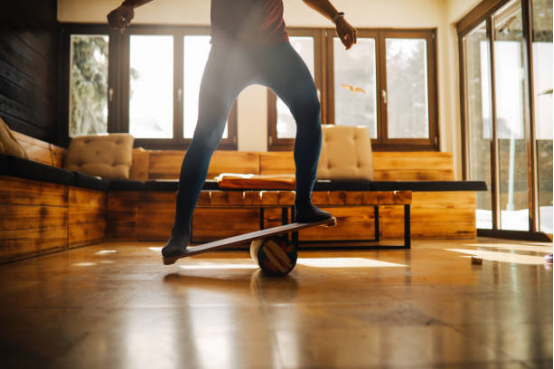
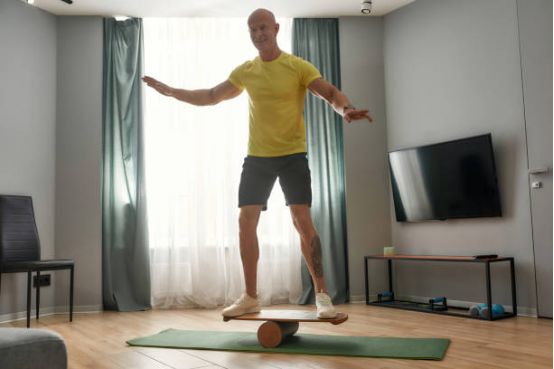
Static balance refers to maintaining body stability without moving, while dynamic balance involves maintaining control while moving. On a balance board, trainees can perform static balance training from a basic standing posture, or perform dynamic challenges by swaying back and forth, side to side, or standing on one leg.
The principle can be broken down as follows:
- Static balance: Slight swaying of the board requires the core muscle groups to make continuous adjustments, stimulating proprioceptors and improving posture control.
- Dynamic balance: Continuous micro-tilts activate neuromuscular coordination, improving joint stability and rapid response capabilities.
This dual training model explains why balance boards are not only suitable for rehabilitation training but are also used by professional athletes to improve athletic performance. By scientifically arranging static and dynamic training, it is possible to simultaneously improve both “muscle group memory” and “neural response memory.”
Neuromuscular coordination and motor performance optimization
Neuromuscular balance training is a core concept in sports science, referring to the ability of the nervous system and muscles to coordinate and control body movement. The instability of the balance board forces the body to adjust its center of gravity instantaneously, and this immediate feedback enhances the efficiency of neuromuscular communication.
Specific manifestations include:
- Improve movement precision and reduce energy waste during exercise.
- Enhance joint protection mechanisms and reduce the risk of sprains or strains.
- Improve agility and reaction speed for smoother training or athletic performance.
For example, basketball players use balance boards in training to practice single-leg ball control or cutting movements, which helps them train core and lower limb coordination through subtle balance adjustments, enabling them to make more precise movements in actual games.
A scientific combination of flexibility, reaction speed and body control
The scientific value of balance boards lies not only in increasing muscle strength, but also in improving overall flexibility and body control. Through gentle, oscillating movements that stimulate all joints and muscle groups, trainees gain the following advantages:
- Increased flexibility: The ankle, knee, and hip joints gain a greater range of motion through fine-tuning.
- Increased reaction speed: In the event of a sudden and unstable situation, muscles can quickly contract and adjust posture.
- Enhanced body control: The coordinated response of the core and accessory muscle groups throughout the body makes daily movements and motor skills more precise.
This comprehensive ability is fundamental to many sports (such as skiing, surfing, basketball, and football), enabling athletes to improve performance while reducing the risk of injury.
Conclusion
Behind the science behind balance board core training lies a systematic approach that activates the vestibular system, strengthens deep core muscles, and enhances neuromuscular coordination and dynamic control. Whether you’re looking to improve your daily posture, boost athletic performance, or seek scientific support in rehabilitation, balance board offers effective and diverse training methods.
Learn more about the specific movements and training programs of balance board , and get more practical guides and scientific training resources to help you comprehensively improve your body control in daily life and sports.