
The first rays of morning sunlight stream through the curtains onto the floor, or the living room after a long day when you’re exhausted and looking for a quick energy boost – this is the perfect time for a balance board to shine. Prolonged sitting leads to stiff muscles, a weakened core, and a slouching gait.
With a carefully designed daily balance routine , you can activate your deep core, improve your balance, and get your body back to its optimal state in just a few minutes. This article will delve into how to perform micro-activation training using a balance board in your daily life and provide practical practice scenarios.

The Scientific Logic of Micro-Activation Training
So-called micro-activation training doesn’t involve completing a high-intensity workout plan. Instead, it uses light, short, and precise movements to activate the core and lower limb neuromuscular systems. Research shows that the vestibular system and deep core muscles slow down in the morning or after prolonged sitting, directly affecting gait stability and body coordination. Short training sessions using a balance board can activate these key muscle groups, allowing the body to quickly enter “working mode.”
Core muscle activation is central to micro-activation training. Compared to traditional sit-ups or planks, balance boards force the body to constantly make micro-adjustments to its posture through an unstable support surface, thereby automatically engaging deep core muscles such as the transverse abdominis, quadratus lumborum, and gluteus medius. More importantly, this training is not limited to muscles but also involves neuromuscular coordination—every tiny tilt stimulates neural feedback, allowing the body to learn to maintain balance more sensitively.
Balanced wake-up in everyday scenarios
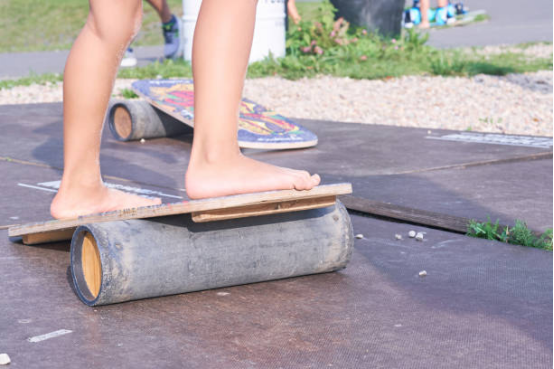
Imagine this scenario: You’ve just woken up, your feet are on a soft carpet, and your balance board sits quietly beside you. In just three to five minutes, you can complete a basic core wake-up workout . The simple movements involve standing on the board with your feet slightly apart, knees slightly bent, and shifting your weight slightly back and forth between your feet; then add a lateral tilt to activate both your core and glutes simultaneously.
Mini-activations after work are equally important. Prolonged sitting can lead to tightness in the front of the hips, stiffness in the shoulders and back, and a slumped posture. A balance board can help re-establish the connection between lower body support and upper body stability. For example, gently tapping the board alternately with your feet, while simultaneously swinging your arms naturally, can stimulate lower body strength and gait coordination, while engaging the core muscles. In this way, the body quickly switches from “fatigue mode” to “activity mode,” relieving stress and improving stability.
Beginner-friendly motion design
For those new to balance boards , safety and ease of use are key. We recommend starting with the beginner balance flow :
- Static standing : Stand with your feet parallel and knees slightly bent, and keep the board gently rocking for 3–5 minutes to allow your core muscles to contract slightly.
- Gentle forward and backward swaying : Shift your center of gravity slightly forward and backward, maintaining even breathing with each tilt. This helps to activate the muscles around the spine.
- Alternate sides : Shift your weight from your left foot to your right foot to enhance lateral stability and activate the gluteus medius and obliques.
- Dynamic gait simulation : Simulate small steps or light treading movements on a board to train lower limb coordination and gait stability simultaneously.
Each movement can be adjusted in time and range of motion according to your own condition. The key is to persist with short, frequent training sessions, rather than long, one-time exercises. After a period of practice, you will find that your body balance, core stability, and lower limb coordination have significantly improved.
Integrating micro-activation into daily life
The most appealing aspect is that this type of training can be seamlessly integrated into daily life. In the morning, you can complete core wake-up exercises in the few minutes it takes to make coffee or wait for water to boil; after getting home from get off work, change into comfortable clothes and do a few sets of balance exercises while watching TV or listening to music. Long-term adherence not only alleviates stiffness and fatigue from prolonged sitting but also enhances athletic performance and daily gait.
In addition, balance board training helps establish habitual body awareness. Every slight tilt and adjustment reminds the brain that “core muscles are online,” subtly improving posture and reducing the risk of injury. Even if you’re not a fitness enthusiast, this daily short-term activation can keep your body alert and coordinated.

Useful tips and tricks
- Choose a suitable environment : Beginners can use a board on a carpet or yoga mat to increase friction and reduce the risk of falling.
- Synchronize breathing with movement : Avoid excessively large movements, maintain natural breathing, and enhance neuromuscular coordination.
- Segmented training : 2–3 times a day, 3–5 minutes each time, can form an effective daily balance routine .
- Advanced approach : Gradually try standing on one leg or light hand gestures to increase core engagement and improve balance difficulty.
With these tips, daily balance board activation training can be truly integrated into home or office environments, making it both efficient and safe.
Summarize
From your first step in the morning to your relaxation time after work, the balance board offers a lightweight yet effective core activation solution. Through a scientifically designed daily balance routine , it not only activates core muscles but also improves gait coordination, enhances balance, and helps the body shake off the fatigue of prolonged sitting. Beginners can start with the Beginner Balance Flow and gradually increase the complexity of the movements to develop a micro-activation training habit that suits them best.
Learn more about core activation and balance training with the balance board to keep your body energized from morning till night.