
In the afternoon office, posture in front of the screen becomes increasingly slumped, leading to lower back pain, weak glutes, and tight shoulders and neck. Compensatory patterns quietly form due to prolonged sitting: gluteal muscle inhibition, core weakness, and lower back compensation. This seemingly insignificant daily habit unknowingly alters our natural movement chain. With the help of a balance board , neglected core and gluteal muscles can be reawakened. Through scientific training, natural posture and power transmission can be restored, allowing the body of those who sit for long periods to regain balance.
This article will analyze the biomechanical logic of sedentary compensation and provide practical training combinations to help you easily implement them in the office or at home.
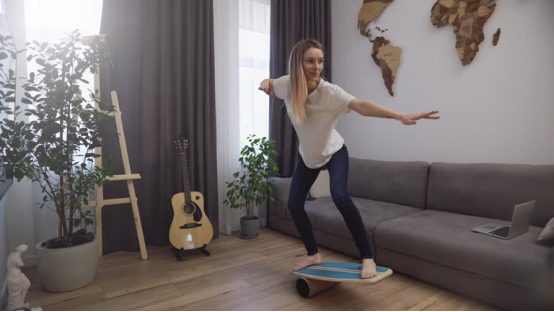
The biomechanical logic of sedentary compensation
Prolonged sitting keeps the gluteus maximus in a state of continuous inhibition. Studies show that prolonged sitting leads to decreased gluteus muscle activity, chronic shortening of the hip flexors, and loss of dynamic stability in the core muscles. To maintain an upright posture, the lower back begins to compensate, eventually leading to excessive lumbar lordosis or anterior pelvic tilt. You will find that even when standing or walking briefly, the hip joints and core lack effective support, resulting in a stiff gait and decreased balance.
In this context, the balance board is not only a training tool but also a bridge between the body and the nervous system. Through its unstable support surface, the board forces the lower limb, core, and gluteal muscles to work together, breaking compensatory patterns and allowing neglected muscle groups to re-engage in movement. For those who sit for long periods, this method can gradually restore gluteal muscle activity and core stability, reduce lower back pressure, and re-establish a natural kinetic chain.
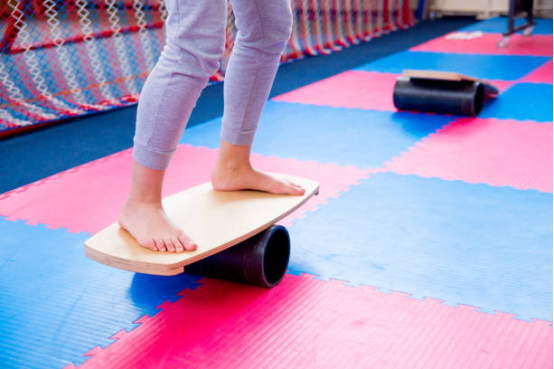
Balance training restores the natural kinetic chain.
When training with a balance board , the focus is on establishing a chain reaction from the glutes to the core and then to the lower body. Glute reactivation board exercises focus on activating the gluteus maximus and gluteus medius. You can start by standing statically: stand on the board with your feet shoulder-width apart, knees slightly bent, and glutes slightly engaged, holding for 3–5 minutes. Engage your core and glutes simultaneously through small forward, backward, and side-to-side tilts.
Advanced training with a balance board can incorporate lower limb dynamic control: light forward and backward steps, alternating lateral movements, or small steps simulating walking. Each tilt and movement requires core stability, which not only trains balance but also strengthens the deep abdominal and back muscles. With consistent practice, this combination of training on the balance board can improve lower back compensation, maintain a neutral pelvic position, and result in a more natural and fluid gait.
For those who sit for long periods, lower back relief balance board exercises are an essential part of the routine. Place the balance board on a safe surface and perform dynamic exercises involving slight forward bends or half-squats. This engages the core and gluteal muscles simultaneously, helping to relieve lower back pressure while improving hip joint mobility. Maintain even breathing during the exercise and keep the incline moderate to avoid overstretching or injury.
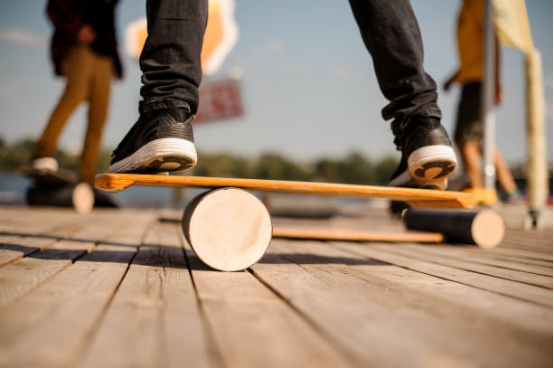
Office and Home Daily Training Program
In an office environment, you can incorporate desk posture recovery as a mini-training routine. During lunch breaks or meeting intervals, stand on a balance board and perform the following exercises:
- Static standing fine-tuning : Keep the board swaying slightly, tighten your hips slightly, and engage your core.
- Forward and backward tilt : Gently shift your center of gravity back and forth to activate your hip flexors and core.
- Alternating left and right : simulates weight-bearing gait of the lower limbs, enhancing lateral stability.
- Single-leg light step : Gradually increase the difficulty to train the engagement of the core and glutes on one side.
Similar workouts can be performed at home after work or upon waking, incorporating light dynamic movements such as half squats, light stepping, or small forward bends to create a complete glute and core activation chain. The flexibility of a balance board allows you to adjust the intensity and combination of movements at any time, without requiring additional equipment or taking up much space.
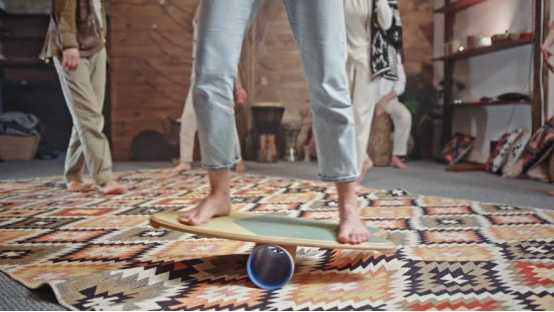
Practical training techniques and precautions
- Progressive training : Gradually increase the difficulty of movements from static to dynamic to avoid over-activation that could cause muscle strain.
- Center of gravity control and synchronized breathing : Moderate range of motion and natural breathing not only enhance neuromuscular coordination but also reduce the risk of injury.
- Training duration and frequency : 2–3 times a day, 5–7 minutes each time, can form an effective daily balance routine to help sedentary people relieve compensatory patterns.
- Posture observation : Use a mirror or camera to check the position of the pelvis, shoulders, and spine to ensure that the quality of the movements is more important than the quantity.
Through these strategies, the balance board is no longer just a training tool, but a tool for restoring the natural kinetic chain in daily life. Sedentary compensatory patterns are corrected, and gait, core stability, and glute strength are improved simultaneously, providing a sustainable posture optimization solution for office and living environments.
Summarize
The compensatory effects of prolonged sitting on the body cannot be ignored: gluteal muscle inhibition, core weakness, and lower back compensation become the norm. With the help of a balance board , scientific training can rebuild the natural kinetic chain, awaken dormant muscle groups, relieve lower back pressure, and improve gait stability.
By combining glute reactivation board and lower back relief balance training with desk posture recovery strategies, sedentary individuals can easily restore dynamic balance and core control in the office or at home.
Learn more about the complete balance board training combination and its daily applications, explore more professional balance training programs, and help your body recover from the fatigue of prolonged sitting and regain strength and vitality.