
Home fitness is no longer an occasional endeavor, but rather an integral part of daily life for many. Whether busy working professionals or parents juggling children and family, finding low-cost, high-efficiency training solutions has become crucial. Against this backdrop, the balance board is gradually emerging as a lightweight core piece of home fitness equipment. Not only is it compact and easy to store, but it also activates core muscles and improves balance and coordination through simple movements, enabling highly effective home workouts.
a balance board for systematic training within a limited space , creating a family balance training program suitable for the whole family .
Home fitness trends and the advantages of lightweight equipment
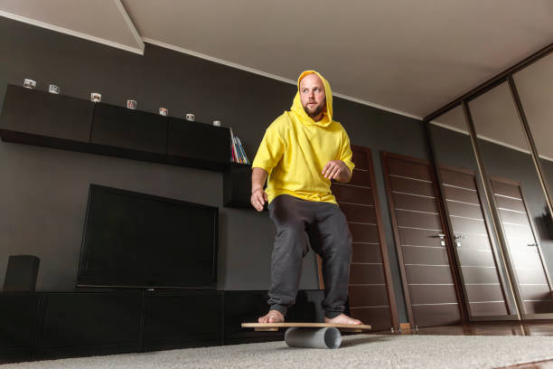
In recent years, home fitness has shown two major trends: lighter equipment and more multifunctional equipment. Most homes do not have enough space to accommodate traditional fitness equipment, and lightweight training tools such as home workout boards or yoga mats perfectly meet this need. Compared to treadmills or dumbbells, balance boards require no extra space and can provide deep core activation, lower limb coordination, and neuromuscular control training.
Another advantage is cost-effectiveness. The lightweight equipment requires minimal investment yet covers a wide range of training goals, from balance and core strength to gait and posture improvement. User experience shows that family members can more easily integrate the balance board into various daily activities such as morning activation, work breaks, and evening relaxation. This high-frequency, short-duration training mode perfectly meets the fitness needs of modern families.
Small space training plan
Even if you only have a corner of the living room or an empty space in your bedroom, the concept of small space fitness gear can still be fully utilized. It’s recommended to place the balance board on a non-slip mat or yoga mat to ensure safety and stability. When planning your training space, consider three key points: sufficient standing area, enough space for the board to move around, and nearby support points (such as against a wall or sturdy furniture).
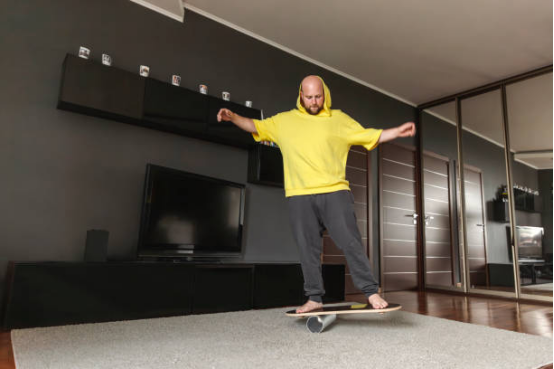
The home training modules can be divided into three main categories: static balance, dynamic core, and gait simulation. Static balance training focuses on basic standing, with feet shoulder-width apart on a board, knees slightly bent, and core slightly engaged. Slight forward and backward, and side-to-side swaying activates the deep core and lower limb muscles. Dynamic core training incorporates slight squats, single-leg standing, or arm movements to create a coordinated chain between the core, glutes, and lower limbs. Gait simulation uses light stepping on the board, lateral movement, or micro-stepping to simulate everyday gait and improve overall neuromuscular response.
Family Member Differentiated Training Program with a Balance Board
Family members differ in body type, strength, and coordination, so family balance training with a balance board needs to be adjusted flexibly. Children and teenagers can engage in gamified activities, such as maintaining balance on a balance board to complete designated movements, which enhances core stability and adds fun. Adults can combine core activation and lower limb strength training using a balance board to improve balance and stability. Older adults can focus on static balance and light dynamic training with the balance board to prevent falls while maintaining the activity of lower limb and core muscles.
Training combinations can be flexibly arranged to suit different levels and objectives:
- Basic startup module: Static standing, slight forward, backward, and left and right swaying on the balance board to activate the core.
- Function enhancement module: Combining half-squats, single-leg standing, and arm movements on the balance board to improve coordination and neuromuscular control.
- Daily life simulation module: Lightly step on the balance board surface, simulate walking or lateral movement, and enhance gait and balance chain.
Through modular training, each family member can complete balance board training suitable for themselves in the same space, achieving family coverage without the need for a lot of extra equipment.
Tips to Enhance Your Training Experience with a Balance Board
Safety first: Beginners are advised to stay close to a wall or stable furniture when using a balance board to reduce the risk of falling.
- Synchronize breathing with movement: Maintain natural breathing, moderate range of motion, and engage the core and lower limbs for stability during balance board exercises.
- Training frequency and duration: 1–2 times a day, 5–10 minutes each time, can form an effective home workout program with the balance board.
- Advanced challenges: Try balancing with your eyes closed, moving dynamically on one leg on the balance board, or holding light weights to increase the difficulty of core and neuromuscular control.
At the same time, planning family training time properly can also increase participation. For example, core activation in the morning, balance exercises during lunch breaks on the balance board, and interactive family games in the evening can enrich the training format and maintain consistency.
Home environment optimization and space integration
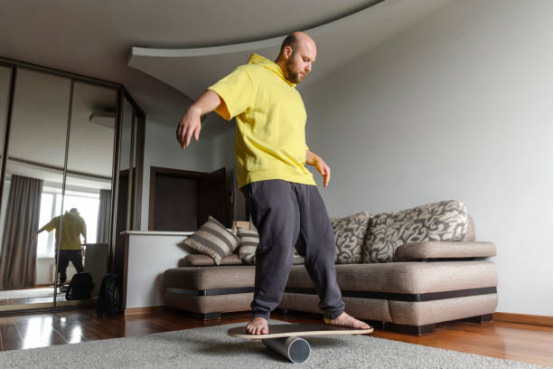
When using a balance board for home training, space layout and environmental optimization are equally important. A multi-functional corner, combined with lightweight storage tools, can integrate the board, yoga mat, and small resistance bands to create a space-saving, high-utilization training area. Wall mirrors or smart cameras can help members observe their postures and improve movement accuracy.
Furthermore, family members can share the training space, creating an interactive family balance training environment. Parents and children can perform training of varying difficulty in the same area, cultivating exercise habits and enhancing parent-child interaction. In this way, the balance board becomes not only a training tool but also a part of family fitness culture.
Summarize
With the increasing popularity of home fitness, balance boards have become a core choice for lightweight home fitness equipment due to their low cost, easy storage, and high training efficiency. Combining scientific training modules and reasonable space planning, they can meet the needs of family members of different ages and skill levels, achieving balance, core, and gait training for the whole family. Through a combination of static balance, dynamic core exercises, and daily life simulations, family members can not only complete efficient training in a small space but also enhance their body coordination and neuromuscular control.
Explore professional balance training strategies to make home fitness easy and efficient, and make the balance board your core training tool at home.