
Among various home training tools, balance boards are often underestimated, but those who have actually used them will find that the stimulation they provide is far deeper than their size suggests. The moment your feet step on it, the micro-muscle groups in your body seem to be activated; with each sway and correction, you suddenly realize that balance is never a passive ability, but a comprehensive training system that can be designed, sculpted, and improved.
Many people think that balance board exercises are just about “standing without falling off,” but when the movements are graded, structured, and incorporated into a wider range of physical tasks such as core, flexibility, and dynamic coordination, its training dimensions will continuously expand like a ladder.
To ensure the content truly helps trainees at all levels, this comprehensive guide divides balance board exercises into various difficulty levels: from basic standing postures, core stability, and single-leg challenges, to advanced training like the roller exercise, and cross-training combinations integrating dumbbells and yoga poses. Each exercise also includes the exercise goals, common mistakes, and progression logic, allowing you to “dynamically upgrade” your training version.
Next, let’s start with the most basic and crucial movements.
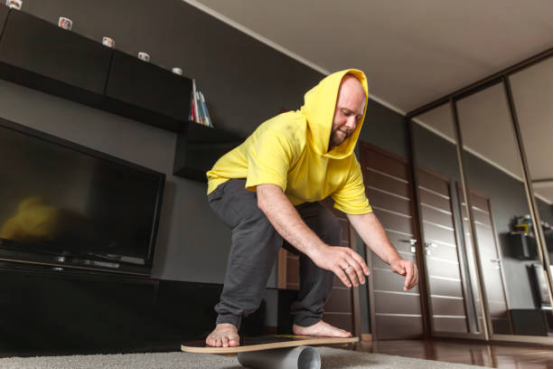
Basic Standing Posture and Beginner Balance Drills
For beginners to balance board, the greatest value of introductory movements isn’t an immediate improvement in stability, but rather getting the body system to “hear the signals.” Whether you’re using a round, longboard, or wobble board-like structure, mastering the basic stance will make subsequent movements more efficient.
Basic standing posture
This is the core of all beginner balance drills. The trainee places both feet parallel in the center of the board, knees slightly bent, with the balls of the feet naturally gripping the ground, while distributing the weight evenly between the forefoot and heel.
The focus of the movement is not “stillness,” but “controlled micro-movements.” The body will make small adjustments, and your goal is to make these adjustments stable and continuous.
Exercise Goal: To activate the ankle stabilizing muscles and improve proprioception.
Common Mistakes: Locking the knees, shrugging the shoulders, and deliberately stiffening the body to maintain balance only increase unnecessary energy expenditure.
Advanced Logic: After being able to hold the position stably for 45–60 seconds, add eye-closing or hand movements.
Transition from sitting to standing posture
This is a movement that beginners often overlook, but it’s a crucial part of balance board training. Slowly rise from a seated position on the board, using your knees to push your center of gravity upwards.
The movement looks simple, but it activates a large number of leg stabilizing muscles.
Action Goal: Strengthen the kinetic chain from the ground to standing.
Common Mistake: Standing up too quickly can cause the board to slip.
Advanced Logic: Add a light object to hold, simulating the everyday “stood up under load” motion.
Static balance of hand support
If the trainee lacks lower body strength or confidence, they can also practice against a wall or support bar. Stand firmly with your feet on the ground and gently touch the support with your hands, rather than “leaning against it.”
This method is ideal for rehabilitation scenarios or adults who haven’t trained for a long time.
Exercise Goal: To build psychological safety and physical anticipation.
Common Misconception: Gripping tightly at a support actually weakens the training effect.
Advanced Logic: Gradually reduce the contact area, from the palm to two fingers.
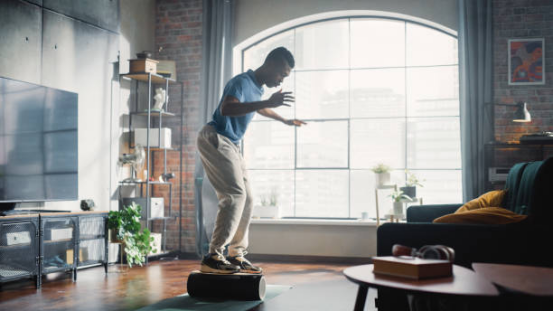
Core stability and dynamic regulation
Once the body is sufficiently familiar with the basic movements, it can elevate balance tasks to the “core-driven” level. At this point, balance board exercises are no longer just about ankle performance, but rather the collaboration of the entire central axis system.
Knee forward and backward movement (Mini Shift Training)
The trainee stands on the board, only slightly pushing forward and pulling back with their knees, without letting the board surface touch the ground directly. The range of motion is small, but requires precise control.
Objective: Improve lower limb joint coordination and core stability.
Common Mistake: Excessive range of motion causes the board to tilt and the player to hit the ground.
Advanced Logic: Incorporate mini shifts in the left and right directions to create a four-directional challenge.
Anterior and posterior pelvic tilt
This is a key movement for improving core control. Keep your upper body stable and let your pelvis tilt slightly back and forth like a clock.
It may seem subtle, but it can significantly strengthen the coordination between the transverse abdominis and lower back muscles.
Goal: Enhance deep core muscle activation.
Common Misconception: Upper body involvement results in the entire spine moving.
Advanced Solution: Increase movement speed or pause duration.
Stability training with arm movements added
When the upper body begins dynamic tasks, the balance board will produce more complex swaying motions.
You can start by:
• Swinging your arms back and forth
• Raising one arm to one side
• Circling your arms.
Objective: To train the body to maintain axial stability under external disturbances.
Common Misconception: Excessive arm movement turns the workout into a “chasing balance” exercise.
Advanced Logic: Adding light dumbbells transforms it into a beginner version of the advanced balance workout.
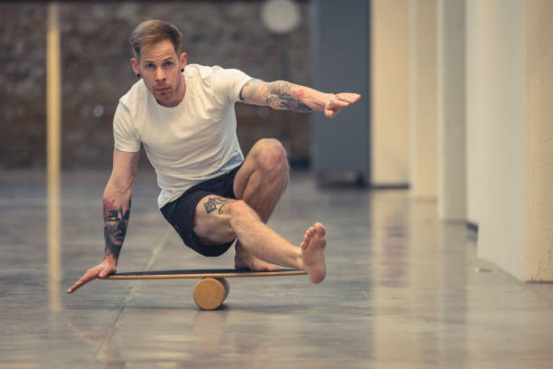
One-legged challenge and motion integration
Once your core and stance are stable enough, single-leg exercises quickly raise the difficulty level to a new level. This stage of the exercise is ideal for athletes, runners, yoga practitioners, or anyone looking to strengthen their lower body.
Standing on one leg
Standing on one leg is one of the most representative exercises in balance board training.
Begin by lightly touching the board with your free foot and gradually lift it off the ground.
Objective: To improve ankle stability, hip control, and body coordination.
Common mistake: Lifting the leg too high causes a shift in the center of gravity.
Advanced steps: Add hand weights, close your eyes, or have the free leg make circular motions.
Single-leg knee raise
Raise the other knee until it is parallel to the hip.
This movement will allow the body to feel the shift in center of gravity more clearly and force the core to make continuous fine adjustments.
Goal: Improve single-leg stability.
Misconception: Lumbar spine compensation causes the body to lean backward.
Advanced logic: Transform the knee lift into a “slow leg lift to extension”.
Single-leg lateral slide
Stand on one leg on the board and slide your supporting leg sideways with a very small amplitude.
Although it seems simple, it provides a great stimulus to the muscles in the sole of the foot and the hip abductors.
Goal: Strengthen the lower limb lateral stability chain.
Common Mistake: Excessive range of motion leads to loss of balance.
Advanced Solution: Add resistance bands to increase lateral resistance.
Roller-type and advanced balance workout
As you prepare to move on to more advanced training, a roller balance board will provide a dynamic feel closer to skateboarding, surfing, and skiing. The range of motion increases significantly, and errors are more likely to occur, so it’s essential to follow a gradual progression approach.
Forward and backward scrolling control
Stand on the roller plate and gently move the plate back and forth along the rollers.
The key is not speed, but the ability to “stop”.
Objective: To train reaction speed, hip alignment, and core synchronization.
Common Mistake: Deliberately sprinting creates excessive momentum.
Advanced Logic: Incorporate target points, such as stopping at a certain point and then returning to the center.
Lateral rollover
Many intermediate and advanced skiers use this movement to simulate the carving feeling of skiing.
The skier shifts their weight from side to side, causing the ski to tilt in a controlled manner before returning to a horizontal position.
Objective: To strengthen the lateral stabilizing chain and the body’s “braking ability.”
Common Mistake: Excessive speed can lead to instantaneous loss of control on the board.
Advanced Logic: Combine movements into S-shaped or large-amplitude carving training.
Dynamic jump landing
Performing small jumps and landing smoothly on a roller board is one of the most challenging training exercises.
It requires extremely fast neural reactions at the moment of landing.
Objective: Improve agility and high-speed balance.
Common mistake: Jumping too high leads to uncontrollable landings.
Advanced solution: Incorporate directional jumps (forward, backward, sideways).
Cross-disciplinary integration of dumbbells, yoga, and flexibility training
When the balance board becomes part of the trainee’s body language, it can be integrated into more complex cross-training. This combination not only enhances the fun of training but also broadens the applicability of the exercise library.
Dumbbell upper body combination
Perform shoulder presses, front raises, or rows using light dumbbells, allowing your body to perform stable tasks on an unstable platform.
These types of exercises are very effective for the shoulders and core.
Goal: Improve upper body strength on a stable platform.
Common Misconception: Using excessively heavy dumbbells leads to poor posture.
Advanced Logic: Combine exercises into a continuous sequence such as “shoulder press + front raise + rowing”.
Balance Board + Yoga
Practicing Tree Pose, Warrior III, or simple forward bends on a board can strengthen static balance and improve body awareness.
Start with very small movements.
Goal: Improve flexibility and dynamic balance.
Common Misconception: Pursuing difficult yoga poses while neglecting body stability.
Advanced Logic: Developing a continuous yoga flow.
Balance Board Flexibility Training
Performing light squats or hip-opening movements on the board will accelerate the response of the feet and knees to flexibility stretches.
Goal: To improve the body’s ability to maintain stability during extension.
Common Misconception: Forcibly increasing flexibility can lead to joint slippage.
Advanced Steps: Incorporate resistance bands or lateral extension exercises.
Conclusion
The balance board may seem like just a simple board to most people at first glance, but its potential is constantly being rediscovered as training progresses from the basic standing position to single-leg, rolling, and crossover combinations. The more movements and variations you incorporate, the stronger your body’s stability chain becomes, even without realizing it. Whether your goal is to improve core strength, athletic performance, or simply to add some fun to your home workout, you can gradually add these movements to your routine in stages.
Explore more balance board exercises or find beginner balance drills and advanced moves that suit you, which may open up more possibilities for your training journey.