
Looking at today’s home workout market, more and more people are paying attention to that seemingly simple little balance board. It’s lightweight, quiet, and can be used anytime, anywhere, yet it can train your stability and coordination in more detail. Whether a good balance board is truly right for you often doesn’t depend on brand reputation, but rather on whether the materials, specifications, and bottom structure match your training goals. Many people don’t understand these differences before buying, resulting in either ineffective use or mediocre results. The real key often lies hidden in the structural design.
Among fitness enthusiasts, rehabilitation trainers, and even skiers and surfers, there are various experiences to share. Some prefer heavy wooden boards because the rebound underfoot provides a greater sense of security; others believe that plastic is more flexible and allows for faster angle changes; and some experienced trainers even specifically choose composite materials because their subtle resilience better suits joint needs. Whether to use a round bottom or a roller board, how big or wide the board should be—without comparison, it’s difficult to know what you truly need.
This balance board material comparison and size guide breaks down the options from the perspectives of material, bottom structure, size, friction, and user goals, helping you find the most accurate and suitable board. As you read, you’ll gradually discover that many differences in training experience are closely related to the board’s physical properties. To further explore balance training, you can also browse our additional content to learn about the structure and selection methods of different training equipment.
Part 1: Differences in resilience among wood, plastic, and composite materials
Material is the most influential factor in terms of feel. If we break down the training experience of a balance board, wood typically offers particularly strong stability. Most natural woods provide slight flexibility under pressure without excessive bending; this rebound, somewhere between firm and soft, makes the user feel more grounded when maintaining a standing position. Many people who regularly do basic balance training prefer this stable yet springy feel. This isn’t just a placebo effect; it’s because the wood’s fiber arrangement generates subtle energy feedback under pressure, reducing foot fatigue.
Plastic offers a different experience. It’s lighter, more flexible, and easier to curve, meaning a faster response when tilting. For users who need to quickly change direction in a short time, the balance board made of plastic is more sensitive, but the trade-off is that more fine-tuning is needed when stable. During training, you’ll clearly feel the frequent involvement of your feet, making your ankle joints more agile. Some describe this feeling as standing on a faster-changing surface; it’s suitable for speed-based training rather than basic steady-state control on a balance board.
The existence of composite materials is like merging the two into a more balanced solution. Balance boards formed by combining wood, fiberglass, resin, and other materials not only have a more stable profile but also a more linear resilience. Composite structures are generally stronger and more resistant to deformation than wood, and more uniform than plastic, less prone to uneven hardness in certain areas. Many professional training institutions prefer this type of material because it provides continuous and predictable rebound, without sudden lightening or localized hardening, making it easier to build motor memory during balance training with a balance board.

Part 2: Comparison of Training Experiences Between Round Bottom and Roller-Style Training Methods
Here we come to the biggest point of divergence on the balance board: the bottom structure.
The round-bottom structure, also known as the common wobble board, is the first choice for many beginners and rehabilitation trainers. The round bottom has a small stress range, and the board tilts in all directions around the center of the ball, preventing sudden slippage. Therefore, you only need to manage angle changes in up/down, forward/backward, and left/right directions. This structure is ideal for training ankle stability and is the most commonly used form in medical institutions. In terms of experience, it feels more like managing body balance than moving the board.
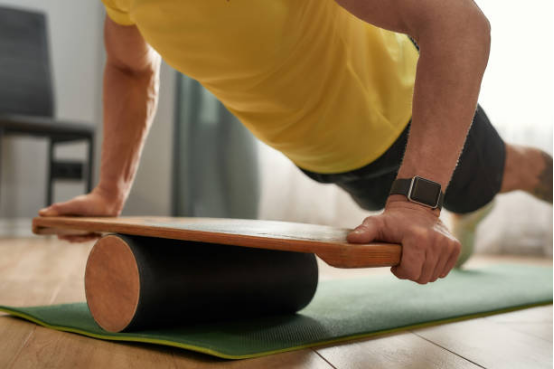
Roller boards are entirely different. The bottom rollers of a roller board are separate, meaning the board not only tilts but also moves left and right along the rollers. Training requires simultaneously managing two types of variables: tilt angle and lateral displacement. This combination can be challenging for beginners, making it easy to lose balance within the first few seconds. However, this is precisely why it’s the most commonly used training equipment for many skiers, surfers, and skateboarders. It simulates a dynamic scenario rather than simply static balance.
If you are comparing wobble vs roller board, you can simply understand it as:
The round base is suitable for slow-paced, stable, and basic training,
while the roller, which emphasizes control, is more suitable for training explosive power, reaction speed, and full-body coordination.
Many experienced users alternate between the two, much like switching between different training modes at different stages. For a deeper understanding of their specific performance in training, our website offers more in-depth articles on techniques and tips.
Part 3: The Influence of Dimensions, Load-Bearing Capacity, Friction, and Board Curvature on Training
Balance board size guidelines are often overlooked, but size does indeed affect training performance. A large board provides stability, while a small board provides agility; these are two completely different things.
The larger the size, the more room your feet have to move, allowing for greater adjustment of your center of gravity and making it easier to master movements. For heavier individuals or beginners, a larger balance board surface reduces the risk of falling, especially noticeable with a rounded sole.
Smaller sizes result in more direct changes in the center of gravity and a faster balance board response. Especially in roller structures, the lateral movement of a smaller balance board is more pronounced and more stimulating, which is why advanced trainees often choose smaller sizes.
The choice of load-bearing capacity must be evaluated based on body weight, training frequency, and intensity of use. Wooden balance boards generally have a higher load-bearing capacity, composite materials offer better fatigue resistance under high-intensity training, while plastic is more suitable for low- to medium-intensity training. If the load-bearing capacity is insufficient, the balance board will develop localized indentations after prolonged use, directly affecting the tilt trajectory and training experience.
In terms of friction, the deeper the texture of the balance board, the stronger the foot’s grip; the shallower the texture, the more it relies on precise center of gravity control. For rehabilitation, stronger friction makes movements safer; for athletic performance or agility training, lower friction allows the foot muscles to engage in more subtle adjustments.
The curvature of the balance board also affects the feel of contact with the foot. If the curvature is large, the foot will naturally turn inward, allowing the inner and outer muscles to work together for stability; if the curvature is small, the balance board surface is closer to the ground, which is more suitable for training needs that focus on joint alignment. In rehabilitation training, special attention is often paid to the curvature to ensure natural and safe movements.

Part 4: How to Choose the Most Suitable Specifications Based on Training Objectives
Different balance training goals will lead to completely different requirements for the balance board. The following explanation, focusing on three main goals, will help you establish a clear selection logic.
Fitness training as the main focus
It is recommended to choose a size with moderate responsiveness and good stability. Wooden or composite materials provide a more solid feel, and the rounded sole structure allows movements to focus on the core and lower body. The board surface should not be too small to avoid excessively fast response that could lead to movement distortion. Higher friction enhances safety and is suitable for movements such as squats, lunges, and core stability exercises.
Rehabilitation training as the main focus
When the goal is to restore ankle or knee control, stability should be prioritized. A rounded bottom is most suitable, and wood or composite materials are preferable, offering linear rebound and high predictability. A larger size is recommended to allow for smoother shifts in the center of gravity and reduce the likelihood of sudden loss of control. A naturally curved surface with high friction helps protect joints and reduces the risk of training accidents.
Focus on athletic performance training
If the goal is sports like skateboarding, surfing, or skiing, or if you want to train speed and reaction time, then a roller structure is more suitable for practical needs. A moderately sized, quick-rebounding plastic or composite material provides a more dynamic feel. The friction should not be too high, so as not to affect the foot’s ability to make fine adjustments when quickly changing direction.
These selection criteria stem from accumulated experience from training institutions, user feedback, and equipment design trends. Different training goals generate highly diverse needs, so understanding structural and material differences can help you find your optimal configuration more quickly. For a deeper exploration of balance training techniques, you can also browse related topics on our website.
Find your perfect board
The material, structure, and size of a balance board may seem like just parameters, but each element profoundly affects training performance. Wood is stable, plastic is fast, and composite materials offer balance; a round bottom emphasizes control, while rollers emphasize reaction time; size determines adjustment space, and friction determines safety and power. By comparing these factors one by one, you can more accurately find your training direction.
If you are evaluating different structures or materials, you can also browse our extended reading for more related analysis to make your choice more confident. Whether your goal is fitness, rehabilitation, or improving athletic performance, choosing the right balance board is like choosing the right language for your body, allowing it to naturally express strength and stability.