How balance board training affects gait and daily movement patterns

Walking on a smooth floor, turning to go downstairs, even getting up from the sofa—every movement seems simple, yet it holds the secrets of body balance. Have you ever noticed that some people walk with ease and grace, while others stumble or tire easily? This is all closely related to our body’s fundamental control abilities, and balance board training is an effective way to improve this ability. Today, we’ll delve into how balance board training can change gait and enhance daily movement patterns by strengthening core and lower limb coordination.
From the gym to everyday life: The underlying impact of balance boards
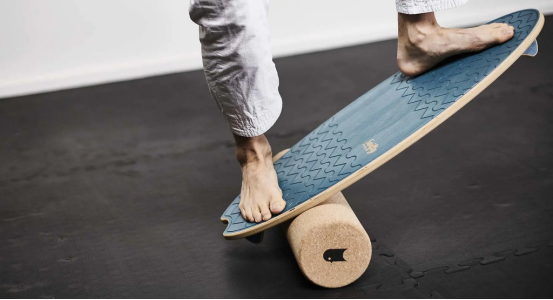
In gyms, balance boards are often seen as balance training tools to enhance core muscles and small joint control. However, their true value goes far beyond that. When we extend our perspective from the training field to daily life, every step—walking, climbing stairs, or turning—requires constant fine-tuning of the body to maintain stability. These fine-tunings are precisely the core manifestation of the “underlying control” trained by balance boards.
Studies have shown that long-term users of balance boards experience significant improvements in gait stability. Enhanced fine-tuning abilities in the core muscles, ankles, and hips allow the body to more accurately predict and adjust for changes in the center of gravity, thus reducing the risk of falls. For example, a study on older adults showed that after eight weeks of balance board training, participants exhibited more even strides in gait tests, reduced gait variability by more than 15%, and experienced a significant increase in confidence in daily activities.
Furthermore, the benefits of balance board gait improvement are also evident in the ability to adapt to complex movements. When you turn quickly, jump over obstacles, or accelerate suddenly, your body no longer relies on a single muscle group for power but instead forms a coordinated chain, with smooth coordination from the chassis to the upper body. This improvement is not immediately apparent but rather gradually manifests through the accumulation of neural adaptation and muscle memory.
The value of balance training in daily activities
In daily life, our bodies constantly face various dynamic balance challenges. Even simple movements, such as getting up from a chair, bending over to pick up an item, or walking on uneven ground, require coordinated control of the lower limbs, core, and upper body. Balance training for walking stability simulates these subtle balance disturbances, allowing the body to learn adjustment strategies in a controlled environment.
Taking climbing stairs as an example, each step tests one’s center of gravity control. Untrained individuals tend to rely on leg strength, neglecting core engagement, leading to uneven load on the knee and ankle joints. However, after balance board training, the neural pathways between the core and lower limbs become more efficient, resulting in smoother weight transfer, thereby reducing joint stress and improving gait consistency and speed control.
Similarly, everyday turning and changing direction movements also benefit greatly. During training, the balance board introduces instability, causing the body to constantly make fine adjustments, thus exercising the coordination of small muscle groups and the vestibular system. With long-term adherence, small-amplitude adjustments of the center of gravity during daily walking become automatic, unconsciously improving movement efficiency and stability.
Neuroadaptation and Long-Term Benefits
Many people believe that balance training is merely about muscle strengthening, but the more important aspect is the adaptation of the nervous system. The long-term benefits of daily movement balance board training often manifest in the optimization of neural adaptation and motor control. During training, the body learns how to quickly perceive balance disturbances and react through coordinated muscle groups; this ability to “predictively adjust” is significantly reflected in gait.
For example, when you’re walking through a supermarket and suddenly step on an uneven surface, someone trained with balance boards will regain stability faster than an untrained person, without stumbling or losing balance. This change stems from an enhanced ability of the central nervous system to regulate the body’s center of gravity in real time, rather than relying solely on muscle strength. In the long run, this not only reduces the risk of falls but also improves daily mobility, allowing the body to perform more easily and naturally in various situations.
Furthermore, research shows that balance board training can improve lower limb joint flexibility and proprioception. Enhanced fine-tuning ability in the knee and ankle joints leads to a more stable gait rhythm, less effort in walking, and reduced daily fatigue. This effect not only impacts athletic performance but also directly affects quality of life.

Comprehensive Application and Practical Recommendations
To transfer the training results of the balance board to daily actions, a multi-dimensional strategy can be adopted:
- Scenario simulation training
incorporates simulations of everyday movements, such as slight lateral shifts, forward and backward steps, or rotational movements, to help the body learn complex gait patterns. - The progressive unstable stimulus
begins with low-difficulty balance training and gradually increases the amplitude of the disturbance, allowing the core and lower limbs to gradually adapt to different balance requirements. - Multi-joint coordination exercises
emphasize the coordination between the upper body and lower limbs, allowing the shoulders, hips, and knees to keep in sync through fine-tuning, resulting in overall gait optimization. - training
Observe your balance when walking, going up and down stairs, and changing direction, and naturally transfer the core control learned in training to your daily life.
It’s worth noting that the effects of balance board training are gradual and lasting. Unlike short-term muscle strength enhancement, it subtly changes gait and daily movement patterns through the integration of neural adaptation, muscle coordination, and underlying control. This is why it is increasingly being adopted by rehabilitation training, athletic performance optimization, and daily stability improvement programs.
If you want to learn more about how to maximize the value of the balance board in different daily activities, learn more practical balance board techniques here to expand your training ideas.
Summarize
From the gym to daily life, balance board training is more than just a balance exercise; it’s a way to strengthen fundamental control. Through the coordinated work of the core, lower limbs, and nervous system, it improves balance board gait, enhances walking stability, and optimizes daily movement balance board performance. Whether going up and down stairs, turning, or walking on uneven surfaces, those who undergo systematic training can achieve a more stable, efficient, and safe gait.
Ultimately, the long-term value of balance board training extends beyond athletic performance; it profoundly transforms everyday movement patterns, allowing the body to maintain confidence and balance with every step. Are you ready to incorporate balance training into your daily routine, making every movement a practice for improving fundamental control?