
At home, in the park, or even in a sun-drenched living room, have you noticed the subtle balance your children maintain while chasing and playing? Their feet lightly touch the ground, yet they always manage to stay stable as they spin and jump. This seemingly casual movement is actually a manifestation of the development of a child’s brain and body coordination. And in this process, a simple tool— a balance board —is quietly becoming a focus of attention for parents and educators. It not only stimulates children’s interest in sports but also promotes the development of their nervous system, motor control, and concentration.
The relationship between balance training and children’s brain development
Children’s brain development is closely related to their motor experiences. Research shows that through consistent balance training, children can enhance the sensitivity of their vestibular system, which directly impacts spatial perception, body positioning, and coordination. A balance board is an excellent tool for parent-child exercise; its unstable support surface allows children to adjust their center of gravity during practice, activating deep muscle groups and cerebellar neural circuits. This interaction not only improves balance but also strengthens the brain’s ability to integrate sensory information.
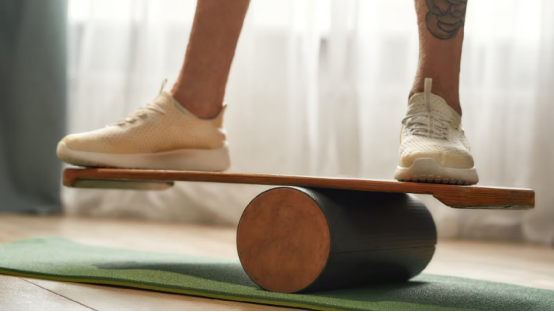
For example, when using a kids’ coordination board , a child may need to stand on one leg, sway back and forth slightly, or move their feet alternately. Each slight sway subtly stimulates the coordinated work of the cerebral cortex and cerebellum, making movements more precise and improving reaction speed and concentration. For parents, this is also an opportunity to observe the details of their child’s movements and discover potential athletic talents.
Child Balance Play from the Perspective of Parent-Child Interaction
Compared to traditional indoor toys or electronic devices, child balance play offers more possibilities for parent-child interaction. Every attempt by children on the balance board is often accompanied by encouragement and guidance from parents. This process not only strengthens the emotional bond between parents and children but also helps children become accustomed to challenges and feedback through play.
In a home setting, training can be divided into several stages: initially, focus on standing on both feet and gently swinging back and forth; in the middle stage, add single-leg balance or small rotations; and in the advanced stage, incorporate hand-eye coordination games, such as catching a ball, spinning a disc, or moving colored markers. This gradual approach not only ensures safety but also keeps children’s interest in exercise high.
Furthermore, playing together as a parent can cultivate children’s social skills and teamwork. Mutual assistance, imitation, and competition among siblings or friends subtly enhance children’s motor control and strategic thinking.
Safety and age-appropriate training methods
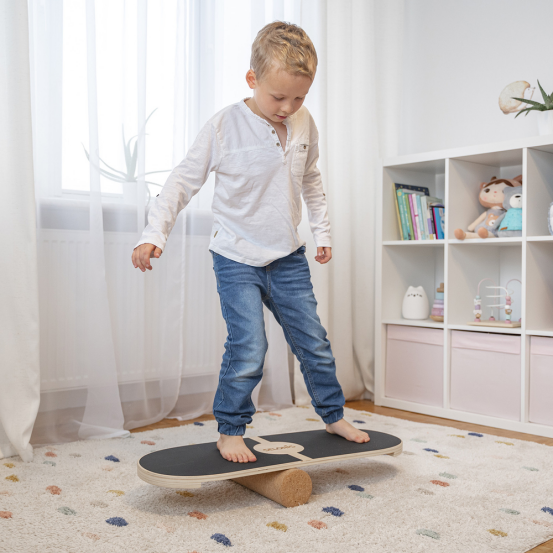
Choosing the right training method for your child’s age is key to ensuring they get the most out of the balance board . For children aged 3–5, a low, lightweight board is recommended, with parental assistance to minimize the risk of falls. Children over 6 can gradually try single-leg balance or small rotations to challenge their stability and coordination.
ChatGPT 说:
Training sessions on the balance board should not be too long, ideally 10-15 minutes each time, to avoid over-fatigue leading to loss of control. Using non-slip mats or placing the balance board on a soft surface can effectively reduce the risk of accidents. At the same time, encourage children to wear comfortable, well-fitting athletic shoes or practice barefoot to enhance their foot awareness. It is important to note that gradual progression on the balance board is more important than overly challenging all at once; this not only ensures safety but also allows children to experience a sense of accomplishment through self-control.
During this process, parents can judge the effectiveness and suitability of the training by observing the subtle adjustments in their child’s center of gravity, the natural swing of their arms, and the engagement of their core. This real-time interactive and feedback mechanism is precisely the unique advantage of balance board training as a family fitness tool in family exercise.

Long-term benefits of balance training
Besides improving motor coordination and reaction speed, children who use balance boards regularly also benefit in cognitive and emotional management. Balance training requires children to concentrate and control the rhythm of their movements, which is crucial for improving focus and executive function. Educational psychology research indicates that children who regularly participate in dynamic balance activities demonstrate higher attention spans and task completion abilities in classroom learning.
Furthermore, balance training can help children build self-confidence and self-awareness. Every successful balance experience is a positive feedback loop, encouraging children to try new movements and face challenges. For parents, this is not only about cultivating physical health, but also about early training in emotional management and psychological resilience.
Integrate the balance board into your family life
In today’s fast-paced lifestyle, balance boards offer a simple and efficient home fitness solution. Whether in a corner of the living room, on the balcony, or in a quiet spot in the children’s room, a few minutes of balance training can provide children with a holistic exercise experience. By regularly scheduling family balance activities, you can not only get your children moving but also make the family atmosphere more active and fun.
For more training inspiration and safety guidance, visit our website to learn how to cleverly integrate balance boards into your child’s daily exercise routine. Our wealth of parent-child interaction suggestions, age-appropriate training programs, and real user testimonials are all practical resources to help families scientifically plan their children’s coordination training.
Balance training is more than just action games; it’s a crucial pathway for children’s brain development, motor control, and concentration improvement. Through parent-child interaction using balance boards and kids’ coordination boards , children learn body control, sensory integration, and emotional management through play. Every slight sway and every attempt at a challenge is a step towards growth and a deepening of the parent-child bond. Integrating this exercise habit into family life not only helps children improve their coordination but also brings health and joy to the whole family.