Is a balance board really more suitable for sedentary people than fitness enthusiasts?

At 3 PM, the screen at my desk is blindingly bright, and my shoulders and neck feel like they’re being crushed by stones. Many sedentary people believe that only gyms, sweating profusely, and weightlifting count as exercise, and that balance boards are only for fitness enthusiasts. But this idea may be outdated.
More and more American offices are incorporating fitness concepts into their daily work routines—standing desks, adjustable chairs, walking meetings, and even placing balance boards at the foot of workstations—not to work out abs, but to revitalize bodies that have become accustomed to slumber. Rather than being exercise equipment, it’s becoming a way to combat a sedentary culture. This raises the question: are balance boards truly more suitable for sedentary individuals than fitness enthusiasts?
The sedentary culture has led to a subtle imbalance in the body, thus reshaping the meaning of the balance board.
What may seem like a peaceful period of sitting is actually a form of chronic fatigue. The American journal JAMA has pointed out that adults who sit for more than 6 hours a day have a significantly increased incidence of lower back pain, metabolic abnormalities, and forward posture. Tight shoulders, posterior pelvic tilt, and weak core muscles—these are not problems faced by fitness enthusiasts, but rather the daily routine of typical office workers.
It’s no wonder that balance boards are moving from gyms into office buildings.
Standing on the board, you constantly adjust your ankles to counteract slight swaying, passively engaging your core muscles and helping your body regain balance. This doesn’t require large movements, and you don’t break a sweat or get out of breath, yet it revitalizes a body stiffened from prolonged sitting. This is why there’s increasing discussion about balance boards for office workers as a low-barrier-to-entry form of balance training, and it’s even being incorporated into work break activities.
In other words, it is not a toy for fitness enthusiasts but a “micro-exercise tool” for sedentary people to reduce postural decline.
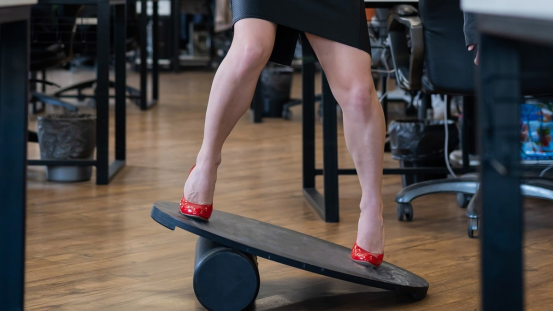
The real subtext of a balance board: posture improvement, not strength training.
Many people misunderstand this board—thinking it’s only needed for training skateboarding, surfing, and core strength. But the core value of balance board posture improvement isn’t training advanced moves but rather restoring the body’s natural alignment, which is disrupted by prolonged sitting.
When standing on the board:
- The stability of the arch and ankle is reawakened
- The pelvis makes subtle adjustments to maintain balance and inhibit posterior tilt.
- The back and abdominal muscles are unconsciously engaged, counteracting hunchback.
- Keep your eyes and head looking forward to reduce neck strain from prolonged periods of looking down.
These changes are subtle, yet perfect for people who spend all day hunched over a keyboard. The U.S. Workplace Health Trends Report explicitly states that micro-movements are more effective than high-intensity exercise in maintaining a sedentary lifestyle. Balance Board meets this need: no need to change into workout clothes or create a gym atmosphere, allowing for a mini “body wake-up” during meeting breaks.
If you’re standing on the board processing emails, holding video conferences, or even brainstorming solutions, your body is engaging in training in a gentle and continuous way, rather than being overworked.
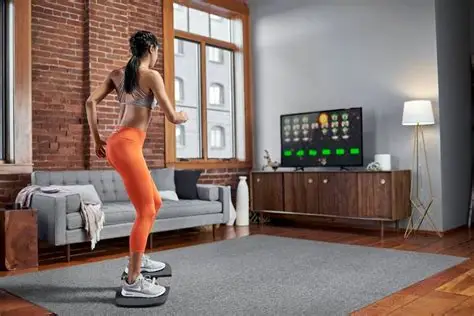
Why balance boards are more suitable for low-activity individuals than you might think.
Fitness enthusiasts buy equipment to improve their performance; sedentary users need a sense of participation that starts from scratch.
Several early adopters in the US shared a common experience: the initial panic of swaying for a few seconds after stepping onto the balance board, as if some dormant system were starting to function again. This unique feeling reveals the real problem for sedentary individuals—not a lack of exercise, but rather that their bodies are gradually forgetting how to coordinate.
This is also a key reason why balance boards are suitable for sedentary lifestyle balance training:
- The barrier to entry is low
, requiring almost no learning curve; simply standing there is training. - Compared to running and weightlifting, which require willpower, balance boards are simple and low-intensity and can be integrated into daily office work without increasing the burden of exercise.
- Spending
5 minutes a day, multiple times a day, is more gentle than spending an hour at once, and the body is more willing to cooperate. - With less psychological pressure
You don’t need to face the mirror or compare yourself with fitness gurus; you only need to face your own body’s signals.
This approach, involving both psychological and physiological engagement, makes it more like a tool for “reclaiming control of the body” than just a training board.

When product labels are misread, the balance board is redefined.
Marketing often associates balance boards with fitness, surfing, and core strength training, misleading users into believing they are not relevant to their lives. However, when the focus shifts to workplace health, sedentary lifestyles, and increased work efficiency, the positioning changes entirely.
In some creative firms and remote teams in the United States, boards have become an integral part of the work environment. They see them as a second work break mechanism besides coffee breaks: taking a break and giving the brain a refresher. A designer in New York shared a scenario—he gets more inspiration when working on design sketches on a board because the slight balancing stimulation keeps his attention focused and prevents his brain from becoming fatigued or dulled.
This illustrates that a balance board is not a substitute for exercise but rather a way to shift the body from a static state to continuous small-scale activities, improving cognitive efficiency through subtle stimuli. While this scenario may not be “cool” enough for fitness enthusiasts, it’s perfect for those who sit for long periods.
Perhaps changing your physique doesn’t require a gym.
We are used to categorizing exercise and labeling people. But as the problem of sedentary lifestyles expands, these boundaries need to be redrawn. The balance board is at the center of this discussion.
Fitness equipment is not just for fitness enthusiasts; the body needs to be cared for, not ignored.
The question returns to its original point: Is a balance board truly suitable for sedentary people rather than fitness enthusiasts?
Perhaps a more accurate statement is that it is opening a gentler door for those who feel pressured to exercise and distant from gyms.
The next time you stand at work, would you be willing to have a gently swaying board under your feet?