The indirect effects of balance board on running and jumping movements

Table of Contents
In gyms or sports fields, you may have seen people standing on balance boards, their feet swaying slightly. But you might wonder if this training actually helps with running or jumping.
In fact, balance boards are not simply balance training tools; they significantly impact body stability, coordination, and neuromuscular control. These factors can indirectly transfer to various athletic performances, including running, jumping, and even ball games and functional training. This article will delve into balance board running performance, balance training jump stability, and the movement transfer effect.

How Balance Board can improve running performance
Core stability and gait control
Running may seem like a simple sport, but every step involves the fine coordination of the hip, knee, ankle, and core muscles.
- Enhanced Gait Efficiency: Studies show that long-term use of a balance board can strengthen core stability and improve the coordinated control of the hip, knee, and ankle.
- Energy Conservation: When the core muscles are more stable, the amplitude of body swing during running is reduced, and energy consumption is lower.
- Neural Adaptation: Numerous sports science experiments have shown that after 6–8 weeks of training, subjects experienced a significant decrease in vertical oscillation during a 5 km run.
Injury prevention and sports sustainability
The performance of balance board running is not only reflected in efficiency but also in injury prevention.
Common knee and ankle sprains during running are closely related to insufficient foot and ankle stability. Through balance board training, the lower limb small muscle groups gain greater responsiveness, reacting faster to uneven ground or sudden changes in force.
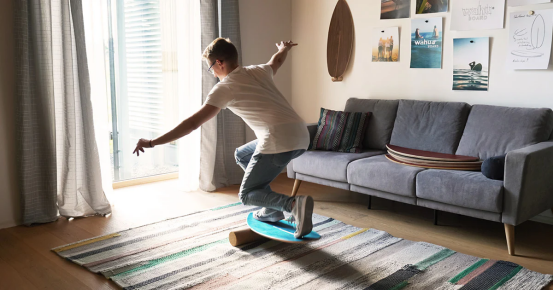
The indirect effect of the balance board on jumping movements
| Improvement Area | Mechanism of Action |
|---|---|
| Explosiveness | Enhances neuromuscular connections and proprioception. |
| Fluidity | Helps athletes quickly adjust posture during jumps. |
| Impact Absorption | Enhances ankle-knee coordination to distribute impact upon landing. |
Improve explosiveness and movement fluidity
Jumping relies not only on leg muscle strength but also on the nervous system’s coordinated control of explosive movements. For example, in basketball or volleyball training, athletes who have undergone balance training show improved landing stability and take-off height in vertical jumps.
Motion control and landing impact absorption
Jumping movements are often accompanied by high impact, especially upon landing. A lack of lower limb stability can increase the risk of injuries such as anterior cruciate ligament (ACL) injuries. Balance boards allow the body to distribute impact more quickly upon landing, improving joint load distribution.
The transfer mechanism from balance training to multi-sports performance
Neural adaptation and motor automation
The core of balance board sports transfer lies in neural adaptation.
In the early stages of training, the body must consciously concentrate on maintaining balance. As training accumulates, movements gradually become automatic, and the ability to fine-tune improves.
Sensory integration and motor coordination
Balance training not only trains muscles but also enhances the integration of the vestibular and visual systems. This results in more flexible athletic performance and quicker reactions to changes in the ground or body position.
Small muscle group activation
Most strength training emphasizes large muscle groups, while balance boards excel at activating smaller lower limb muscles and deep core muscles. Enhanced stability of the medial lower limb muscles can significantly reduce the risk of knee valgus during running.
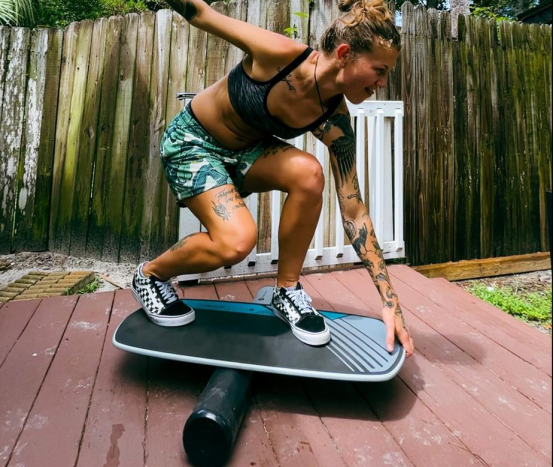
Practical Applications and Training Strategies
Comprehensive benefits for people who exercise more
Whether you’re a runner, a high jumper, or a basketball player, a balance board offers indirect benefits. Athletes can experience smoother motion chains, higher movement efficiency, and a lower risk of injury.
Training time and intensity recommendations
- Frequency: 2–3 exercises per week.
- Duration: 10–20 minutes each time.
- Variations: Try closing your eyes, standing on one leg, or adding slight dynamic movements to increase the cross-movement transfer effects.
Data-driven and feedback optimization
In modern sports training, the use of motion tracking devices can quantify the effects of balance board sports transfer. Through data feedback—such as gait analysis or stability scoring—athletes can intuitively understand the indirect benefits.
Summary and Action Tips
A balance board is not just a balance training tool but also a comprehensive training method for whole-body neuromuscular control and coordination. It indirectly improves running efficiency and jumping stability while reducing the risk of sports injuries.
Standing on the balance board isn’t just about challenging your balance; it’s also about planting the seeds of potential for full-body athletic performance. The next time you accelerate, jump, or change direction, its indirect effects may have already subtly changed the way you exercise.