Balance Board Yoga Flow: Increases stability in Warrior III and Tree Pose by 200%

Is your yoga mat too “comfortable”?
For many yoga practitioners who have been practicing for more than a year, we often fall into a comfortable “plateau.” Your feet have memorized the texture of the yoga mat, and your muscle memory allows you to even be distracted by thinking about what to eat for dinner while doing Vrksasana (Tree Pose).
Awareness begins to fade when the body no longer needs to struggle for balance.
This is precisely why we need to introduce the Balance Board.
Don’t think of it as just a surfer’s toy; in many advanced core flow yoga workshops, it is quietly replacing yoga blocks, becoming the ultimate yoga prop that increases the difficulty of yoga and seeks “absolute stability” through “instability.”
Today, we’ll explore how to place this wobbly board under your feet and transform each simple standing action into a deep neuromuscular workout.
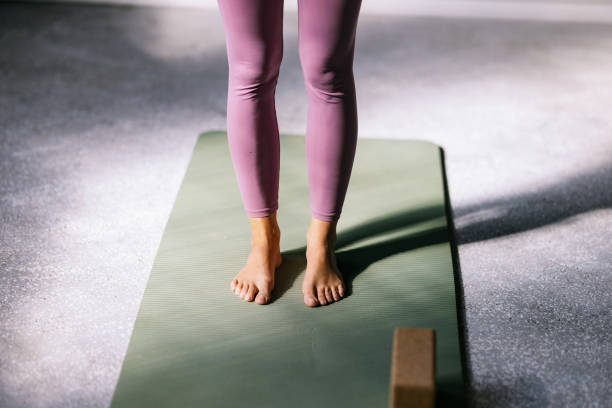
Why can instability lead to greater stability?
On flat ground, our skeletal structure does most of the supporting work. You can “lock” your joints and rely on ligaments to hang there while the muscles are doing nothing.
Once you step onto the balance board, that right to slack off is instantly taken away.
1. Force activation of deep core (Deep Core Activation)
To prevent the edge of the board from touching the ground, your body must engage the transverse abdominis and multifidus. These deep stabilizing muscle groups, which are usually difficult to reach on a mat, must maintain continuous, high-frequency micro-contractions. This is no longer a simple stretch but a high-intensity Core Vinyasa.
2. The Hidden Mula Bandha (Root Lock) and Pelvic Floor Muscles
This is the most fascinating side effect of the Balance Board yoga flow. To control the board’s center of gravity, you must instinctively lift and contract your pelvic floor.
This natural contraction to maintain balance is far more effective than consciously practicing Kegel exercises on a mat. This is why it’s considered an excellent tool for pelvic floor muscle repair by physical therapists—it allows the repair to occur unconsciously against gravity.
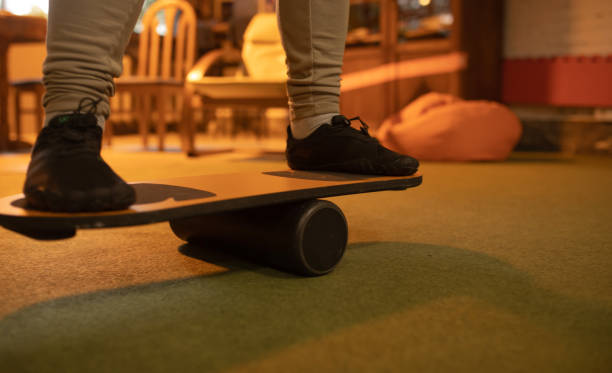
When classic yoga poses meet Balance Board
Warning: Please use a gently sloping rocker board or place a thick blanket under the rollers to increase friction. Do not attempt high-intensity roller patterns on your first try.
1. Tree Pose Variation: From Static to Dynamic Equilibrium
On flat ground, the tree shape is static. On the Balance Board, the tree shape is dynamic.
Execution details: Place your supporting leg in the center of the board. When you lift your other leg and place it on the inside of your thigh, the board will immediately tilt to one side.
At this point, you not only need to stabilize the center line by pushing against each other with the insides of your thighs but also need to constantly fine-tune the pressure at four points on the soles of your feet (big toe ball, little toe ball, and sides of the heel) like playing the piano.
Training effects: This fine-tuning greatly strengthens the arch of the foot and transmits the energy upwards along the fascial chain, activating the gluteus medius.
You’ll find that holding your position on a board for 30 seconds is more tiring than standing on flat ground for 5 minutes; the soreness in your thighs and glutes will tell you: this is true activation.
2. Warrior III: The Ultimate Trial of the Core
Warrior III is inherently difficult to balance; if you add a balance board, it will become a “lie detector” to test your core integrity.
Execution details: Many people unconsciously open their hips when performing Warrior III to raise their back leg.
However, on a balance board, if the pelvis is misaligned, the board will immediately tilt violently to one side. To keep the board level, you must force yourself to internally rotate your thighs and align your pelvis.
Advanced technique: Try to maintain a T-shaped balance on the board. Your core must connect your upper and lower body like steel. This resistance will allow you to experience unprecedented spinal extension.
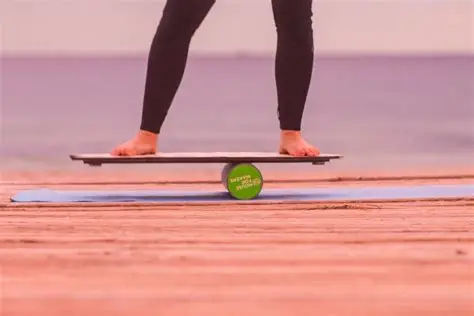
Material and Flow: Stability comes from wood.
For practitioners seeking a holistic approach to mind and body, the tactile feel of the equipment is crucial.
Unlike cold rubber balls or plastic balance mats, high-quality balance boards are typically made from multiple layers of pressed birch or maple wood.
Walking barefoot on the warm, smooth wood not only provides better slip resistance but also a sense of grounding, connecting you with nature.
Even though the board itself is unstable, the wood’s feedback is solid and warm. This aesthetic fit allows it to blend perfectly into your home yoga corner, rather than looking out of place like gym equipment.
Finding Zen in the Shaking
The Yoga Sutras say, “Sthira Sukham Asanam” (the posture should be stable and comfortable).
Introducing the balance board into practice isn’t about pursuing acrobatic high-difficulty performances but about finding inner composure amidst extreme instability.
When you can steadily maintain the Warrior III stance on a swaying board, the moment you return to flat ground, you’ll find your foundation is deeper than ever before.
This is not just about increasing the difficulty of yoga; it’s about reshaping your perception of gravity.
FAQ
Q1: Can beginners use the balance board to do yoga directly?
Not recommended. If you can’t maintain a stable one-legged stance on flat ground for more than 30 seconds, or if your core strength is weak, going directly onto the balance board can easily lead to falls or sprains.
It’s recommended to practice basic yoga poses on a yoga mat first and then add the balance board as an advanced challenge.
Q2: Which type of balance board is suitable for yoga practice?
For yoga practice, a Wobble Board (with a hemispherical base) or a Rocker Board (with an arc-shaped base) is more suitable than a skateboard-style Roller Board. The former two offer 360-degree or left-right tilt but don’t cause the board to fly off like a roller, making them better suited for holding static poses and connecting core flow yoga poses.
Q3: Does this help with postpartum recovery?
Very helpful. As mentioned in the article, balance board training is an excellent exercise for pelvic floor muscle repair.
This is because it induces reflexive firing of the pelvic floor muscles through an unstable plane. This involuntary firing is often deeper and more effective than conscious control.
However, postpartum mothers must begin with a seated position or standing with support against a wall under the guidance of a professional rehabilitation therapist.